Guides
Getting found in search and AI answers
How Google and AI answer engines find a website, and what to fix when yours is missing.
 Guide
Latest
How to launch a vibe-coded app: what to fix and where
Launch a vibe-coded app in order: your own domain, real HTML for crawlers, no keys in the bundle, signup tested, then launch sites that accept a live app.
Every guide, by topic
274Indexing 40
 Guide
'URL is not on Google' in URL Inspection: what every detail line means
'URL is not on Google' means the page can't appear in Search. The Page indexing lines below it name the blocker: discovery, crawl, noindex or canonical.
 Guide
Alternate page with proper canonical tag: is it a problem?
Alternate page with proper canonical tag means Google honoured your canonical and indexed that URL. It only hurts when a template canonicalises every page.
 Guide
Blocked by robots.txt: fix the rule without unblocking the wrong pages
Blocked by robots.txt means a rule stops Googlebot fetching the URL. Find the group Googlebot obeys and the longest matching rule, then edit that line.
 Guide
Blocked due to access forbidden (403): unblocking Googlebot
A 403 to Googlebot usually comes from bot protection, not your app. Find the layer in your WAF logs and allow verified crawlers by IP, never by user agent.
 Guide
Canonical tags for SEO: setup and the mistakes that break them
A canonical tag is one absolute rel=canonical link in the page's head. The mistakes that make Google ignore it, each with a quick test.
 Guide
Crawl budget: does a small site need to care?
Google's crawl budget guide is for sites with a million pages, or 10,000 changing daily. What a small site should fix instead, and how to read Crawl Stats.
 Guide
Crawled - currently not indexed: what it means and how to fix it
Crawled - currently not indexed means Google fetched the page and chose not to index it. Triage by URL pattern, then merge, noindex or improve each page.
 Guide
Discovered - currently not indexed: why Google hasn't crawled it yet
Discovered - currently not indexed means Google knows the URL but postponed the crawl. Check server capacity in Crawl Stats, then raise demand with links.
 Guide
Domain property vs URL-prefix property in Search Console: which to add
A Domain property covers every subdomain and protocol and needs DNS verification. A URL-prefix property covers one exact prefix. Most sites need both.
 Guide
Duplicate without user-selected canonical: how to fix it
Google found duplicate URLs with no canonical and picked one itself. Add one absolute self-referencing canonical per page, and 301 http and www duplicates.
 Guide
Duplicate, Google chose different canonical than user: why it happens
Google treats rel=canonical as a hint and weighs redirects, sitemaps, links, HTTPS and hreflang. Make every signal name one URL and Google usually follows.
 Guide
Excluded by 'noindex' tag: find where the noindex comes from
Excluded by noindex tag means Google saw noindex in a robots meta tag or an X-Robots-Tag header. Find which one with curl and view-source, then remove it.
 Guide
Google Indexing API: can you use it for regular pages?
No. Google says the Indexing API only covers pages with JobPosting or BroadcastEvent markup. For other pages, use sitemaps, links and Request indexing.
 Guide
How long does Google take to index a new website? What speeds it up
Google says crawling takes a few days to a few weeks, and most sites wait three days or more per new page. A sitemap and links from indexed pages help.
 Guide
How to check if a page is indexed by Google (and why site: lies)
URL Inspection in Search Console is the reliable check: URL is on Google or not, with the reason. A site: search shows only a partial sample.
 Guide
How to get Google to index your site faster
You can't force Google to index a site. You can remove blockers and give it reasons to crawl: a sitemap, links from indexed pages, and a few requests.
 Guide
How to get your site indexed by Bing (and why it matters for Copilot)
Import your site to Bing Webmaster Tools from Search Console, submit the sitemap and turn on IndexNow. Microsoft Copilot answers from Bing's index.
 Guide
How to set up Google Search Console for a new site
Add a Domain property, verify it with a DNS TXT record, submit your sitemap, inspect the homepage, then read three reports in week one. The full setup.
 Guide
How to submit a sitemap to Google Search Console (and Bing)
Submit your sitemap in Search Console's Sitemaps report, list it in robots.txt and add it to Bing Webmaster Tools. Include only canonical 200 URLs.
 Guide
Indexability checkers: tools that show why a page can't be indexed
LaunchScaler, Search Console URL Inspection, Bing URL Inspection, Rich Results Test, Screaming Frog and Sitebulb, compared by what each can tell you.
 Guide
Indexed, though blocked by robots.txt: why it happens and the fix
Google indexed the URL from links without reading it, because robots.txt blocks the crawl. Unblock it and add noindex to drop it, or unblock it to rank it.
 Guide
IndexNow: what it is, which engines use it, and how to set it up
IndexNow tells Bing, Yandex and other participating engines a URL changed. Google does not use it. Set it up with one key file and one POST request.
 Guide
noindex, follow: does Google follow links on a noindexed page?
At first, yes. Google says a page left on noindex long enough is dropped and its links stop being followed, so noindex, follow ends up like nofollow.
 Guide
Not found (404) in Search Console: which to fix and which to leave
Most 404s in Search Console are harmless. Fix the ones your sitemap or own pages link to, and 301 URLs with backlinks to their closest equivalent page.
 Guide
Orphan pages: find the pages only your sitemap links to
An orphan page is in your sitemap but no internal link reaches it. Find orphans by diffing the sitemap against a crawl, then link or remove each one.
 Guide
Page indexing report: every 'not indexed' reason and its fix
The page indexing report shows which URLs Google left out and why. Every reason, whether it needs fixing, and the exact fix for each one.
 Guide
Page with redirect in Search Console: when to ignore it or fix it
Page with redirect means the URL redirects, so Google indexes its target instead. Ignore it unless your sitemap or internal links still use the old URL.
 Guide
Redirect error in Search Console: loops, long chains and bad URLs
Redirect error means Googlebot hit a loop, a chain that was too long, an overlong URL or a bad URL. Trace every hop with curl, then redirect in one step.
 Guide
Request indexing in Search Console: the limits and when it works
Request indexing lives in URL Inspection and has an unpublished daily quota. Repeat requests don't help; a rejection means the live test found a blocker.
 Guide
robots.txt and noindex checkers: tools that find what blocks a page
Six robots.txt and noindex checkers compared: LaunchScaler, Search Console's report and URL Inspection, Bing's tester, an extension and Google's parser.
 Guide
robots.txt example for a SaaS site: what to allow, what to block
A commented robots.txt for a SaaS site: marketing pages open, /app/ and /api/ closed, a Sitemap line, and how Google treats a missing or failing file.
 Guide
Server error (5xx) in Search Console: find the cause and fix it
Server error (5xx) means Googlebot got a 500-level status or a timeout. Find when it happened in Crawl Stats, match it to your logs, then fix the cause.
 Guide
Sitemap could not be read or couldn't fetch: the causes and fixes
Couldn't fetch can be transient, but a sitemap that stays unread is usually blocked, redirected, not XML or over 50,000 URLs. Check each cause with curl.
 Guide
Sitemap lastmod: the format and when Google uses or ignores it
Sitemap lastmod uses W3C Datetime, such as 2026-09-28T09:00:00+00:00. Google trusts it only when it is consistently accurate, so set it from real edits.
 Guide
Soft 404 in Search Console: what counts as one and how to fix it
A soft 404 is a page that looks missing or empty but returns HTTP 200. Return 404 or 410 for gone pages, and fix pages whose content failed to load.
 Guide
Trailing slash in URLs: does it matter for SEO?
Google treats /page and /page/ equally, but as two URLs. Pick one, redirect the other and use it everywhere. Settings for Next.js, Vercel and Netlify.
 Guide
Why are some of my pages not indexed by Google when others are?
Inspect one missing page in URL Inspection. Its result names the branch: unknown, blocked, crawled or discovered but not indexed, or a duplicate.
 Guide
WordPress site not indexed by Google: the settings to check first
Check WordPress in this order: the Discourage search engines box, SEO plugin noindex settings, one sitemap, coming-soon mode, firewalls, then cached pages.
 Guide
www vs non-www: pick one and redirect the other correctly
Neither www nor non-www ranks better. Pick one host, 301 the other in one hop, and align DNS, HSTS and Search Console so only one copy of your site exists.
 Guide
X-Robots-Tag vs robots.txt vs meta noindex: which one to use
robots.txt controls crawling; meta robots and X-Robots-Tag control indexing. Which to use for pages, PDFs and folders, plus Nginx, Vercel and Next.js.
AI visibility 45
 Guide
AEO vs SEO vs GEO: what's actually different
SEO wins a ranked link, AEO the direct answer, GEO a citation inside ChatGPT or Perplexity. What each needs, what they share and how to measure them.
 Guide
Agentic Browsing in PageSpeed Insights: how to pass its audits
Agentic Browsing is Lighthouse's newest category, scored as audits passed, not 0 to 100. Every audit in it, what fails it and the fix for each one.
 Guide
AI crawler user agents: the list for robots.txt and logs
Every major AI crawler user agent and robots.txt token, with its operator, purpose, JavaScript rendering and published IP list, checked September 2026.
 Guide
AI crawlers, 404s and redirects: how broken URLs cost citations
Vercel measured ChatGPT's crawler spending 34.82% of fetches on 404s and 14.36% on redirects, against 8.22% and 1.49% for Googlebot. How to cut the waste.
 Guide
Best GEO and AEO tools: what each one actually checks
GEO and AEO tools compared by what they measure: site readiness, prompt tracking or brand mentions, with engines, prompt limits and verified prices.
 Guide
Bing Webmaster Tools AI Performance report: see when Copilot cites you
Bing's AI Performance report counts how often Copilot and Bing's AI summaries cite your pages and shows the grounding queries behind them. How to use it.
 Guide
Brand mentions vs backlinks in AI search: a 75,000-brand study
In Ahrefs' 75,000-brand study, web mentions correlated with AI visibility at 0.66 to 0.71, backlinks at 0.22. Where a young product should earn mentions.
 Guide
ChatGPT describes your product wrong: how to correct what it says
You can't edit ChatGPT's answer, but you can fix what it reads. Find the page a wrong description came from, correct it at the source, then recheck.
 Guide
ChatGPT rank trackers: tools that check if it mentions your brand
Seven ways to track whether ChatGPT mentions your brand, compared by engines covered, prompts, how often they run and price, checked September 2026.
 Guide
ChatGPT recommends your competitors but not you: how to close the gap
When ChatGPT names competitors and not you, list who wins each prompt, open the sources it cited, and get onto those pages. A step-by-step gap analysis.
 Guide
ClaudeBot vs Claude-SearchBot vs Claude-User: what each crawler does
ClaudeBot collects training data, Claude-SearchBot indexes pages for Claude's search and Claude-User fetches pages users ask for. Each obeys its own group.
 Guide
Cloudflare blocking AI crawlers: check it and allow the right ones
Cloudflare can block AI crawlers before robots.txt is read. Where each setting lives, how to test with curl, and how to allow AI search bots only.
 Guide
Content freshness and AI citations: dates, dateModified and lastmod
Perplexity cited content about 3x fresher than Google in one study. Put an accurate date in three places, visible, schema and sitemap, and never fake it.
 Guide
Do AI crawlers render JavaScript? What GPTBot and ClaudeBot see
Most AI crawlers do not run JavaScript: GPTBot, ClaudeBot and PerplexityBot read raw HTML only. One curl command shows what they see on your page.
 Guide
Does ChatGPT use Bing or Google for search?
ChatGPT search queries partner search providers, including Microsoft's Bing, and crawls with its own OAI-SearchBot. Here is what OpenAI documents.
 Guide
Does schema markup help AI search? What the evidence says
Google says AI features need no special schema. What controlled studies show about schema and AI citations, and the six types a SaaS site actually needs.
 Guide
Entity SEO for a new brand: get Google and AI to recognise you
Entity SEO makes search engines and AI models treat your company as one known thing. A one-week plan: one name, schema, matching profiles, Wikidata.
 Guide
Generative engine optimization (GEO): what the research supports
GEO is optimizing content to be quoted inside AI answers. The 2023 paper that named it found citations, quotes and statistics lifted visibility 30 to 40%.
 Guide
Generative engine optimization services: what a GEO agency should do
Real GEO services fix AI crawler access, rendering and quotable passages, then earn third-party mentions and measure citations before and after.
 Guide
Google-Extended: what blocking it does, and doesn't, do
Google-Extended is a robots.txt token, not a crawler. It opts you out of Gemini training and Gemini app grounding, not Search or AI Overviews.
 Guide
How to create a Wikidata entry for your company
Check Wikidata's notability test, create the item, add the four core statements with references, then link the Q-ID from your Organization schema.
 Guide
How to get cited by Microsoft Copilot
Copilot grounds its answers in Bing search, so get indexed in Bing, push changes with IndexNow and read Bing's AI Performance report for citations.
 Guide
How to get cited by Perplexity: become a source it favours
Allow PerplexityBot, answer questions where Perplexity looks (Reddit and niche directories), keep pages fresh and dated, and write self-contained answers.
 Guide
How to get cited in Google AI Overviews
Google cites pages in AI Overviews that are indexed and snippet-eligible, with no special markup. Then it picks passages that answer a sub-question.
 Guide
How to get your product mentioned by Claude
Claude learns about a product three ways, one Anthropic crawler each. Allow Claude-SearchBot and Claude-User, serve real HTML, and earn mentions.
 Guide
How to get your website cited by Gemini
Gemini grounds its answers in Google Search, so get indexed first, keep Google-Extended allowed, and give Google clean entity signals it can match.
 Guide
How to make your website usable by AI agents
AI agents fail on challenges, fake buttons, unlabelled fields, hover-only menus and moving layouts. The test and the fix for each, in the order to check.
 Guide
How to measure AI visibility: prompts, share of voice, citation rate
Measure AI visibility by hand: 10 buyer questions, 7 engines, 4 metrics (mention rate, citation rate, share of voice, accuracy), and how to read the noise.
 Guide
How to opt out of Google AI Overviews (and what it costs you)
Search Console now lets you pull a site out of AI Overviews and AI Mode together. Page-level options, what each costs, and why Google-Extended isn't one.
 Guide
How to optimize for AI search: one checklist for every AI engine
AI search optimization is four checks: bots can fetch you, read you, quote you, and find others vouching for you. A pass/fail test for each.
 Guide
How to rank in ChatGPT search: what decides which sites it cites
ChatGPT answers from live search or from what the model already knows. How to get into each: allow OAI-SearchBot, serve HTML, earn listings, then measure.
 Guide
How to rank in Google AI Mode, and how it differs from AI Overviews
AI Mode splits a question into many searches and cites pages that answer each part. Be indexed, answer every sub-question, and track it apart from AIO.
 Guide
How to see if GPTBot, ClaudeBot and PerplexityBot crawl your site
Three ways to see AI bot traffic (server logs, Cloudflare's AI Crawl Control, host log drains) and how to verify real bots against published IP ranges.
 Guide
How to track ChatGPT and Perplexity traffic in GA4
GA4 has an AI Assistant channel since May 13, 2026. How to find ChatGPT and Perplexity visits, and build a custom AI channel group with the regex to paste.
 Guide
Is FAQ schema deprecated? What FAQPage markup still does
Google stopped showing FAQ rich results on May 7, 2026, after limiting them in 2023. FAQPage is still valid schema.org. What to keep, remove and write.
 Guide
llms-full.txt vs llms.txt: which one to publish
llms.txt is a short index of links; llms-full.txt is your whole content in one Markdown file. When each is worth it, and how to build both on deploy.
 Guide
llms.txt: what it is, who reads it, and whether you need one
llms.txt is a Markdown file of links for AI agents. Google does not use it, coding agents do, and Lighthouse now audits it. How to write one.
 Guide
OAI-SearchBot vs GPTBot vs ChatGPT-User: which OpenAI crawler to allow
GPTBot collects training data, OAI-SearchBot feeds ChatGPT search and ChatGPT-User fetches pages for users. Block GPTBot, allow the other two.
 Guide
Organization schema markup: the exact JSON-LD for a startup
A complete Organization JSON-LD block for a startup home page, every property Google documents explained line by line, plus how to validate it.
 Guide
PerplexityBot and Perplexity-User: robots.txt rules to stay citable
Allow PerplexityBot in robots.txt and in your firewall to appear as a Perplexity source. Perplexity-User fetches for users and mostly skips robots.txt.
 Guide
Reddit and AI citations: how brands show up in Perplexity and ChatGPT
Reddit is 46.7% of the citations among Perplexity's top ten sources. Why AI answers lean on Reddit, and how to take part without breaking subreddit rules.
 Guide
robots.txt for AI bots: block training, keep citations
A copy-paste robots.txt that disallows AI training crawlers and allows AI search and user agents, one commented group per bot, plus the traps to avoid.
 Guide
Should you block AI crawlers? A decision table by bot
Block AI training crawlers if you want to; it costs no citations. Keep AI search bots and user agents open if you want AI answers to recommend you.
 Guide
Why AI answers cite third-party sites instead of your homepage
AI answers lean on reviews, listings and comparisons because buyer questions are comparative. What the citation studies show, and which pages to be on.
 Guide
YouTube and AI visibility: the strongest signal most founders ignore
YouTube mentions tracked AI visibility at about 0.737 across 75,000 brands, above every other factor. A video plan for a product with no video team.
Technical SEO 50
 Guide
301 vs 302 vs 307 vs 308 redirects: which one to use
301 and 308 are permanent, 302 and 307 temporary; 307 and 308 keep the request method. Which code to use for moved pages, domain changes and HTTPS.
 Guide
Article schema with author markup that follows Google's guidance
A BlogPosting JSON-LD example with author, dates and image done Google's way: a Person with a url, one entry per author, dates matching the page.
 Guide
Bolt.new SEO: getting a Bolt-built site indexed
Get a Bolt site indexed: check which framework it uses, publish publicly on your own domain, add robots.txt and a sitemap, then verify in Search Console.
 Guide
Broken internal links: find every 404 your site links to
Find broken links by crawling from your homepage plus your sitemap, then fix each link at its source or 301 the URL when other sites still link to it.
 Guide
Console errors on your landing page: which ones break signups
Most console errors are noise. Uncaught exceptions, unhandled rejections and failed scripts on the signup path are not. How to find and catch them.
 Guide
Content-Security-Policy example for a SaaS, with a safe rollout
A nonce-based starter Content-Security-Policy for a SaaS, the report-only rollout that shows every violation first, and the Next.js proxy setup.
 Guide
Cookie banner requirements under GDPR: no tracking before consent
A GDPR cookie banner sets nothing optional before consent, puts Reject all beside Accept all, pre-ticks nothing and eases withdrawal. How to test it.
 Guide
Core Web Vitals assessment failed: which metric to fix first
The assessment fails when LCP, INP or CLS misses Good at the 75th percentile of 28 days of real Chrome data. How to read it and which metric to fix first.
 Guide
Core Web Vitals checkers compared: what each one measures
LaunchScaler, PageSpeed Insights, Lighthouse, Search Console and CrUX Vis compared: which read real-user field data, which run lab tests, and why.
 Guide
Cumulative Layout Shift: the causes and the fix for each
CLS is Good at 0.1 or less at the 75th percentile. The common causes (images, embeds, fonts, banners, animations) and the CSS or HTML that fixes each.
 Guide
Favicon not showing in Google search results: Google's requirements
Google shows a favicon only if the homepage links it, it's square and at least 8x8 px in a supported format, and Googlebot can fetch both. Check each.
 Guide
Google Consent Mode v2: the four signals and default denied
Consent Mode v2 sends ad_storage, analytics_storage, ad_user_data and ad_personalization. Set all four to denied before tags load, then update on consent.
 Guide
How to improve Largest Contentful Paint (LCP): fix the slow sub-part
Split LCP into four sub-parts, compare each to its budget and fix the slow one: server time, a late or lazy hero image, a heavy file or blocked rendering.
 Guide
hreflang tags: return tags, x-default and the errors that void them
hreflang tells Google which URL serves which language. Every page must list itself and each alternate with valid codes, or Google ignores the pair.
 Guide
HSTS header: the settings, preload requirements and the risks
The Strict-Transport-Security value for testing, production and preload, what the preload list requires, and why removal from it takes weeks to months.
 Guide
HTTP to HTTPS redirect: set it up once, correctly
Redirect every http:// request to https:// on the same host with one 301 or 308, then add HSTS. Setup for Nginx, Cloudflare, Vercel and Netlify.
 Guide
Hydration errors in Next.js: causes, fixes and whether they hurt SEO
A Next.js hydration error means server HTML and the first client render differ, so React rebuilds the tree. The causes, the fix for each, and the SEO cost.
 Guide
Image alt text: rules for SEO and accessibility, with examples
Alt text rules for each image type: content, decorative, linked, charts and screenshots, with a good and a bad example of each and the HTML to use.
 Guide
Interaction to Next Paint (INP) is poor: find the slow interaction
INP is Good at 200 ms or less and poor above 500 ms. Find the slow interaction with the web-vitals attribution build, then break up its long task.
 Guide
Is client-side rendering bad for SEO? What Google and AI bots see
Google renders JavaScript later, in a queue; most AI crawlers never run it. How to test what each sees in a React SPA, and the fixes that work.
 Guide
Is your .env or .git folder public? How to check in 30 seconds
Two curl commands show whether your .env or .git folder is public. What a leak looks like, why deleting the file is not enough, and the rotation steps.
 Guide
LinkedIn link preview not showing: Post Inspector and the causes
Run the URL through LinkedIn's Post Inspector, then fix what it shows: missing og tags, an image under 1200 x 627 px, a blocked LinkedInBot or a redirect.
 Guide
Lovable SEO: why your Lovable site isn't indexed and how to fix it
New Lovable apps render on the server; older ones are pre-rendered for verified crawlers. Find your stack, then fix domain, sitemap, robots and titles.
 Guide
Meta description length: 155 characters on desktop, 120 on mobile
Google cuts snippets at about 920 px on desktop (about 155 characters) and 680 px on mobile (about 120). Put the whole claim in the first 120.
 Guide
Meta description not showing in Google: why Google picks other text
Google swaps a meta description that doesn't fit the query. It never shows one missing from the raw HTML, stuck behind invalid head markup or blocked.
 Guide
Mixed content errors on HTTPS: find and fix every http:// resource
Browsers block http:// scripts, styles, iframes and fetch calls on HTTPS pages and upgrade images and media. How to find every insecure URL and fix it.
 Guide
Next.js Open Graph image not working: metadataBase and caching
Set metadataBase to the production domain, use opengraph-image, keep page openGraph objects from dropping the image, and test outside Vercel protection.
 Guide
OG image not showing: fix WhatsApp, Slack, LinkedIn and X previews
Most missing OG images are fetch failures: a relative URL, a blocked crawler, a login wall or tags added by JavaScript. Check each, then clear the cache.
 Guide
OG image size: the dimensions that work on every platform
Use 1200 x 630 px (1.91:1), PNG or JPEG, under 5 MB, with width, height and alt declared. How Facebook, LinkedIn and X crop it, and where to keep text.
 Guide
React Helmet and SEO: why meta tags don't show in link previews
React Helmet sets meta tags after JavaScript runs, so Google sees them late and link-preview bots never do. Why, and how to put the tags in the HTML.
 Guide
Redirect chains and loops: how many hops before Google gives up
Googlebot follows up to 10 redirect hops, then reports an error. How to map every chain on a site with curl, fix loops and collapse each to one hop.
 Guide
Reduce unused JavaScript in Next.js, React and Google Tag Manager
Lighthouse flags any script with over 20 KiB of unused code. The fix for each source: tag manager tags, below-the-fold components and whole libraries.
 Guide
Security headers checklist: the headers every site should send
The six security headers every site should send, the value for each, the Mozilla Observatory penalty for a missing one, and how to set them on any host.
 Guide
SoftwareApplication schema for SaaS: JSON-LD Google accepts
Google's software app rich result needs name, offers.price and a real rating or review. A complete SaaS JSON-LD example and the rating rules.
 Guide
SPF, DKIM and DMARC for a startup domain: the exact records
Copyable SPF, DKIM and DMARC records for Google Workspace, Microsoft 365 and sending services, and the order to tighten DMARC to reject safely.
 Guide
Structured data errors: fix 'Missing field' and invalid JSON
A structured data error (critical issue) blocks the rich result; a warning doesn't. How to fix missing fields, invalid JSON and wrong value types.
 Guide
Thin content: how many words is too few?
Google has no minimum word count. A page is thin when it doesn't fully answer its query. How to test that, then expand, merge or noindex it.
 Guide
Time to First Byte is slow: server, CDN and cache fixes
TTFB is Good at 0.8 s or less and poor above 1.8 s. Walk the request path (redirects, DNS, TLS, CDN, server, database) and fix the stage that's slow.
 Guide
Title tag length: how many characters before Google cuts it off
Google cuts desktop title links at about 600 px, roughly 50 to 60 characters. Titles over 70 characters get rewritten almost every time.
 Guide
v0 app SEO: the Next.js metadata v0 leaves out
v0 builds Next.js apps, so SEO comes from the metadata API. The files to add: metadataBase, generateMetadata, sitemap.ts, robots.ts, OG image, icons.
 Guide
Vibe coding security scanners for Lovable, Bolt and v0 apps
Nine security scanners for vibe-coded apps, ranked by the layer each one sees: the live site, the builder's code, the database or the repository.
 Guide
Vibe-coded app not indexed? SEO for Lovable, Bolt, v0 and Cursor
AI-built apps miss Google for the same reasons: content only in JavaScript, no sitemap, a builder subdomain, one title on every page. How to fix each.
 Guide
Vibe-coded app security checklist: what to check before you launch
Security checks for an AI-built app, each with a one-line test: keys in the bundle, Supabase without RLS, public .env files, headers, loose CORS.
 Guide
Viewport meta tag: the line that makes a page mobile-friendly
Set the viewport meta tag to width=device-width, initial-scale=1, never user-scalable=no, then test mobile with Lighthouse and device mode.
 Guide
WebP vs AVIF for websites: size, quality and support
AVIF is usually smaller than WebP at the same quality but encodes more slowly. All major browsers now support both, so serve AVIF with a WebP fallback.
 Guide
Website button not working? Test every CTA and form before launch
A button that does nothing is usually a clickable div, a form with no submit path, a thrown handler or a banner on top. The test that finds each.
 Guide
Website security scanners: what free scanners check and what they miss
Free website security scanners compared by what each checks: headers, TLS, DNS, exposed files, malware or active attacks, and what none can see.
 Guide
What a SaaS privacy policy must include: the GDPR Article 13 list
GDPR Article 13 lists what a SaaS privacy policy must say: who you are, each purpose and legal basis, every recipient, transfers, retention and rights.
 Guide
Why Google rewrites your title tags, and how to stop it
Google rewrites titles that are half-empty, vague, duplicated, stuffed or over 70 characters, or that disagree with the H1. How to fix each one.
 Guide
X (Twitter) card not showing an image: the tags X reads
Set twitter:card to summary_large_image, give X an image it can fetch, allow Twitterbot, then test in the post composer. X caches cards for up to 7 days.
Launching 42
 Guide
After launch day: why traffic drops and what keeps a product found
Launch traffic drops because every launch board resets daily. What keeps a product found after that: indexed pages elsewhere, reviews and your own content.
 Guide
Are directory submissions still worth it for SEO?
Directory submissions help when the directory is curated, indexed and visited, and hurt as link-scheme footprints. How to tell them apart, per Google.
 Guide
Best product launch platforms in 2026: 27 sites compared
27 product launch platforms compared in November 2026 on price, the wait for a launch date and the link terms, each from the platform's own pages.
 Guide
Best time to launch on Product Hunt: 12:01 am PT, and which weekday
Launch on Product Hunt at 12:01 am Pacific, the start of its 24-hour day. Weekdays took about 509 upvotes to win in September 2026, weekends about 313.
 Guide
Build in public: what to share so launch day has an audience
Build in public means sharing progress, numbers and decisions while you build. What to post in the weeks before launch, where, and what to keep back.
 Guide
Buying Product Hunt upvotes: what happens and what to do instead
Buying Product Hunt upvotes breaks its rules and can get your launch removed and your account banned. Bought votes bring no users; open paid placements do.
 Guide
Directory submission services: what 100-directory packages get you
Bulk directory submission packages list you on 100+ directories they rarely name. What they include, what Google's link spam policy says, and what to ask.
 Guide
Do launch and directory listings get indexed? How to check yours
Many directory listings never reach Google's index. Check yours with a site: search and URL Inspection, and see why thin or noindexed pages drop out.
 Guide
Free launch queue vs paid launch date: is skipping the line worth it?
Skipping a launch queue costs $14.99 to $39.99 and buys a date, not votes. When a fixed date is worth it, and the wait and price on each platform.
 Guide
How to get your first 100 users
Your first 100 users come from outreach to people with the problem, communities where they ask, a launch spike and content. Each channel, ranked by effort.
 Guide
How to get your first paying SaaS customers
First paying SaaS customers come from charging early, talking to every signup to find the ones with budget, and being where buyers compare products.
 Guide
How to launch a SaaS product: a six-week plan for a solo founder
Launch a SaaS alone by working back six weeks from a fixed date: positioning and pricing, then readiness and listing copy, then dates and supporters.
GuideHow to launch a vibe-coded app: what to fix and where
Launch a vibe-coded app in order: your own domain, real HTML for crawlers, no keys in the bundle, signup tested, then launch sites that accept a live app.
 Guide
How to launch an AI product: where AI tools get discovered in 2026
Launching an AI product means showing real output without a signup, stating your data handling and model providers, and pages AI crawlers can read.
 Guide
How to launch on Product Hunt: submission, first hour and the rules
Launching on Product Hunt is free: sign in, click Submit, paste your link, fill in the fields, pick a date that goes live at 12:01 am PT and hunt it yourself.
 Guide
How to launch on Show HN: the rules and a post that gets read
Show HN takes things people can try now, never landing pages or signup walls. The rules, the title format, why posts get flagged, and the post itself.
 Guide
How to promote your app for free: the channels that still work
Promote an app for free by making it findable in search and AI answers first, then free launch sites, communities and content that answers buyer questions.
 Guide
How to promote your app on Reddit without getting banned
Promote an app on Reddit by reading each subreddit's rules, helping first, disclosing you built it and posting only where launches are allowed.
 Guide
How to relaunch a product: when it works and where to do it
A relaunch works after a change big enough to judge fresh. The relaunch rules of Product Hunt, Uneed, BetaList and Show HN, and what counts as enough.
 Guide
How to write a directory listing that gets clicks
A listing that gets clicks has a one-liner for the job, a description of problem, method and audience, highlights with numbers, and a price stated plainly.
 Guide
How to write a product tagline for launch sites
A launch tagline says what the product does and who it's for in plain words, inside the form's limit (60 characters on Product Hunt). Formula and examples.
 Guide
Is Product Hunt worth it in 2026? What a launch gets you
Product Hunt is worth it for tools makers and early adopters try on the day: free, a day of attention, feedback and a lasting page. Featuring is not yours.
 Guide
Is your website ready for launch day? A 20-minute pre-launch check
A 20-minute website launch checklist: indexing, link previews, signup and checkout, speed under load and HTTPS, in the order a failure would hurt.
 Guide
Launch week: a day-by-day plan across launch platforms
A Monday-to-Sunday launch week that gives each platform its own day: what to post, when, who answers comments, and what to measure every evening.
 Guide
Launching on Indie Hackers: what to post and where
Indie Hackers is a founder forum, not a launch site. Add your product page, earn posting access, then post numbers, lessons and failures.
 Guide
LaunchScaler alternatives: 12 places to launch, checked
Twelve LaunchScaler alternatives for a launch day, a lasting listing or a followed link, with each site's price and link terms checked in November 2026.
 Guide
LaunchScaler vs BetaList: free queue vs paid review
BetaList charges every submission and editors pick who is featured, refunding the rest. LaunchScaler lists free from a queue and ties its link to a scan.
 Guide
LaunchScaler vs Product Hunt: which launch fits your product
Product Hunt is a free, one-day launch where votes and featuring decide visibility. LaunchScaler scans your site and keeps a permanent listing. Use both.
 Guide
LaunchScaler vs SaaSCity: free launch or paid listing
SaaSCity has been paid only since 6 November 2026: Basic $19.99, Premium $39.99. LaunchScaler's free launch needs a badge or fee; Premium is $29, any day.
 Guide
LaunchScaler vs Uneed: queues, prices and links compared
Uneed's free line waits at least 50 days and ties the link to upvotes; LaunchScaler ties it to a site scan. Queues, prices, links and reviews compared.
 Guide
Product Hunt alternatives in 2026: 26 launch sites compared
26 Product Hunt alternatives checked in November 2026: the free route, the paid price, the wait for a date and the link terms each site publishes.
 Guide
Product Hunt launch checklist: every asset and setting to prepare
Every Product Hunt launch asset and its limit: 60-character tagline, 500-character description, 240x240 logo, 1270x760 gallery and first comment.
 Guide
Product Hunt launch not featured? What the featuring guidelines say
Product Hunt features launches that are useful, novel, high craft or creative, and skips waitlists, templates and services. Check yours, then relaunch.
 Guide
Product launch mistakes that waste launch day
Most launch-day failures show up the day before: a leftover noindex, broken previews, a failing signup, no UTMs. Each mistake and the check that finds it.
 Guide
SaaS directories in 2026: 63 places to list, free and paid
63 SaaS directories checked in November 2026, grouped into launch, review, alternatives, AI and developer sites, with free routes, prices and link terms.
 Guide
SaaS launch checklist: the week before, launch day, and the week after
A SaaS launch checklist in three parts: site readiness the week before, platform timing on launch day and follow-up the week after, each with its guide.
 Guide
SaaS launch strategy: pre-launch, launch week and the month after
A SaaS launch strategy in three phases (pre-launch, launch week, the month after), each with one goal, the work behind it and the metric that proves it.
 Guide
Soft launch vs hard launch for a SaaS: when to do each
A soft launch opens your SaaS to a small group to find what breaks; a hard launch is a public, dated push. Goals, audience, risk and a sequence using both.
 Guide
Startup directories worth submitting to in 2026
Startup directories compared by cost, wait and link terms, each checked on its own site: LaunchScaler, Product Hunt, Uneed, BetaList, SaaSCity and more.
 Guide
Waitlist landing page: what to put on it so launch day has an audience
A waitlist page needs a one-line promise, who it's for, what joining gets them and a form that works, plus the tags that let it rank and share early.
 Guide
Where to submit an AI tool: directories ranked
AI tool directories ranked by cost, review and link terms, each checked on its own site, and which ones curate submissions versus accept almost anything.
 Guide
Which launch platforms give a dofollow link, and on what condition
Which launch platforms give a dofollow backlink and the condition each sets (a passing scan, votes, a badge or a fee), quoted from their own pages.
Content automation 35
 Guide
'Alternatives' pages: comparison content that ranks and stays accurate
Competitor alternatives and X vs Y pages that hold up: every claim sourced and dated, one table with the same fields, who each suits, checked quarterly.
 Guide
AI blog writers that publish to WordPress, compared
AI blog writers for WordPress compared on the WordPress side: plugin or application password, draft or live, categories, tags and featured images.
 Guide
Best AI SEO writers in 2026: what each one actually automates
AI SEO writers compared by how much of the job they do: plan-to-publish, draft plus scoring, or drafting only, with price, topic data and publishing.
 Guide
Blog autopilot tools: what they automate safely and where they stop
Blog autopilot tools can automate topic research, drafts, scheduling and publishing. Facts, claims and the final approval should stay with a person.
 Guide
Blog post structure for SEO and AI answers: a template
An SEO blog post template: query-first title, the answer in two sentences, question H2s, numbered steps, tables, FAQ, sources and one call to action.
 Guide
Content brief template for SEO and AI answers
A content brief template with every field filled for a sample article: queries, intent, the two-sentence answer, sources, question headings, links and CTA.
 Guide
Content refresh: which old posts to update first
Refresh posts that lost clicks over the last 3 months first, then posts ranking 4 to 20. How to find both in Search Console and what an update must change.
 Guide
Content ROI: how to measure what a blog post earns
Content ROI = (value of signups a post brings − what it cost) ÷ its cost. How to fill in each number from GA4, and why to judge at 90 days and 12 months.
 Guide
Cost of a blog post in 2026: freelance, agency or AI engine
A 1,500-word post costs about $375 to $675 at freelance median rates; agencies quote by project; an AI engine costs a few dollars. What each includes.
 Guide
Cross-posting to Medium without hurting SEO: the import tool
Publish on your own site first, then use Medium's Import a story tool, which backdates the copy and sets a canonical link to your original.
 Guide
Does Google penalize AI content? What Google's guidance says
Google does not penalize content for being AI-written. It demotes unhelpful pages and treats AI used mainly to game rankings as spam. The check to run.
 Guide
E-E-A-T for a SaaS blog: bylines, first-hand experience and sources
E-E-A-T is how Google's raters judge quality, not a score. On a SaaS blog it shows as first-hand evidence, bylines, sources and Article markup.
 Guide
Google Search Console MCP: connect GSC to Claude for a content plan
A Search Console MCP server lets Claude query your GSC data. Connect it read-only through a restricted account, then ask for queries ranking 4 to 20.
 Guide
Google's helpful content questions as a pre-publish checklist
The helpful content system joined Google's core ranking in March 2024. Its self-assessment questions, as yes/no checks to run on every draft.
 Guide
How long should a blog post be for SEO?
Google has no preferred word count. Make a post as long as its query needs: check what ranks, match that depth, and answer in the first two sentences.
 Guide
How many blog posts per week to rank? Frequency vs quality
Google has no posting-frequency ranking factor. Publish as often as you can review: one to three posts a week for most small sites, daily only with a plan.
 Guide
How to get a new blog to rank: the first 30 posts on a new domain
Get the site indexed first, then publish 30 posts on narrow questions in linked clusters, and expect weeks to months. The order a new domain needs.
 Guide
How to turn Search Console queries into a content plan
Turn Search Console queries into a content plan: export them, group variants by intent, use Query groups if you have them, and map each group to a page.
 Guide
How to write content that AI answers cite
Answer in the first two sentences, write 40 to 60 word passages under question headings, and back claims with sources and statistics. Rules with examples.
 Guide
Internal linking for a new blog: how many links and where
Link each new post from two pages Google already indexes, with descriptive anchors and hubs linked to spokes. How many links, where, and finding orphans.
 Guide
Keyword cannibalization: find it in Search Console and fix it
Keyword cannibalization is two of your pages competing for one query. Spot it in Search Console, then merge with a 301, differentiate, or re-point links.
 Guide
Programmatic SEO vs editorial content: which a small SaaS should do
Programmatic SEO builds many pages from one dataset; editorial answers one question per page. Start editorial, and add programmatic where you own data.
 Guide
Publish blog posts to Webflow CMS through the API
Create and publish a Webflow CMS post with the Data API v2: a cms:write token, the collection's field slugs, HTML rich text and the rate-limit headers.
 Guide
Publish to Ghost with the Admin API: keys, JWT and a working request
Create a custom integration for the Admin API key, sign a 5-minute HS256 JWT with audience /admin/, and POST HTML to /ghost/api/admin/posts/?source=html.
 Guide
Publish to WordPress with the REST API and application passwords
Create a WordPress post with POST /wp-json/wp/v2/posts and an application password: working curl and JavaScript with categories and a featured image.
 Guide
Publishing articles to any CMS through a signed webhook
Verify webhooks by recomputing HMAC-SHA256 over the raw body, comparing in constant time, rejecting stale timestamps and deduplicating IDs. 30 lines.
 Guide
Scaled content abuse: how to publish daily within Google's policy
Scaled content abuse is Google's policy against many pages made mainly to rank, by any method. What it covers, and how to publish daily and stay clear.
 Guide
SEO content calendar: a 30-day template for a SaaS blog
A filled-in 30-day SEO content calendar: one slot a day, each cluster's hub before its spokes, improvements last, and review time before each publish date.
 Guide
SEO content strategy for SaaS: plan 30 articles from Search Console
Build a SaaS SEO content strategy from your own Search Console: queries ranking 4 to 20, improve or write, topic clusters, and a 30-day calendar.
 Guide
Shopify AI blog writers: tools that write and publish to your blog
Shopify AI blog writers compared on where topics come from, whether posts go live or wait as drafts, and listed price, checked in September 2026.
 Guide
Should you change the date when you update a blog post?
Only after a significant update. Keep the original published date, add a visible Updated date, match dateModified to it, and move lastmod at the same time.
 Guide
Striking distance keywords: find positions 4 to 20 in Search Console
Striking distance keywords are queries ranking 4 to 20. Export them from Search Console, filter by position and impressions, then improve the ranking page.
 Guide
Topic clusters for SEO: hubs, spokes and the links between them
A topic cluster is a hub page for a broad question plus spokes for narrow ones, linked both ways. How to build one from your own Search Console queries.
 Guide
Using Notion as a blog: SEO limits and settings
Any Notion plan can make a Site indexable, but titles, descriptions and custom domains need a paid plan, and no schema or robots.txt setting is documented.
 Guide
WordPress application passwords not showing: the causes and fixes
The Application Passwords section disappears when WordPress can't detect HTTPS or a plugin disables it. Every cause, how to spot it, and the exact fix.
Monitoring 15
 Guide
Best SEO monitoring tools: LaunchScaler Watch and the alternatives
LaunchScaler Watch, Search Console, Semrush, Ahrefs, Screaming Frog, Little Warden, UptimeRobot and more, compared on what they watch, how often and price.
 Guide
Google organic traffic dropped? Diagnose it in this order
When Google organic traffic drops, check tracking, then indexing, then rankings, then AI Overviews and seasonality. The order, the reports and the tells.
 Guide
Google Search Console email alerts: what they cover and miss
Search Console emails you about new issues, manual actions and security problems, after Google crawls them. What it sends, the delay and the gaps.
 Guide
Monitoring Core Web Vitals over time: field data lags 28 days
Search Console's Core Web Vitals report uses 28 days of field data, so a regression shows slowly. Add real-user monitoring and lab checks to see it sooner.
 Guide
Noindex on your production site: catch it before Google drops you
A noindex reaches production through a staging env var, WordPress's Discourage search engines box or a host header. Find it, remove it and recover.
 Guide
robots.txt changed without you knowing: how to monitor it
One robots.txt line can block Google or AI search bots. Changes come from deploys, plugins and CDNs, so diff the file on a schedule and test each bot.
 Guide
SEO monitoring for a small site: what to watch and what to alert on
SEO monitoring for a small site: uptime every few minutes, indexing directives on every deploy, a technical scan every two weeks, Search Console monthly.
 Guide
SEO regressions after a deploy: what a release silently breaks
A deploy can break SEO without breaking the page: noindex from staging, a changed canonical, content moved client-side, lost redirects, slower INP.
 Guide
Site migration SEO checklist: domain, platform or URL changes
A site migration keeps its rankings when every old URL 301s to its one new URL. The before, during and after checklist, built around the redirect map.
 Guide
SSL certificate expiry: check the date and catch problems early
Read an SSL certificate's expiry date with one openssl command, script the check, and fix the setups where auto-renewal quietly fails.
 Guide
Staging or preview site indexed by Google: remove it and prevent it
To remove an indexed staging site, password-protect it or add noindex, use the Removals tool for speed, and never block it in robots.txt first.
 Guide
Tracking AI visibility over time: know when you drop out of AI answers
Track AI visibility with a fixed prompt set, the same engines and a fixed schedule, scoring mention, citation and accuracy, and watch your AI access too.
 Guide
Traffic dropped after a redesign: what changed and how to fix it
Traffic drops after a redesign when URLs, content, internal links, titles or rendering changed. Diff the old and new site on each and fix what moved.
 Guide
Uptime monitoring vs SEO: why a 200 OK can still lose rankings
Uptime monitoring checks your server answers. SEO monitoring checks crawlers can index what it answers. What each catches, and why you need both.
 Guide
Website change monitoring tools: which ones catch SEO-breaking changes
Eight website change monitoring tools, from LaunchScaler Watch to Visualping and Distill.io, judged on whether they catch the changes that cost rankings.
Growth 25
 Guide
Backlink checkers: free and paid tools compared for a new site
LaunchScaler's full audit, Search Console, Ahrefs, Semrush, Moz and Bing compared on what their free backlink checkers show, index size and freshness.
 Guide
Domain Rating: what DR measures and what a high-DR link is worth
Domain Rating is Ahrefs' 0 to 100 logarithmic score of a site's backlink profile. Google doesn't use it, and a link's worth depends on the page it sits on.
 Guide
GA4 key events: track signups by source
GA4 renamed conversions to key events in 2024. Fire a sign_up event, mark it as a key event, and read signups by source/medium in Traffic acquisition.
 Guide
Guest posting in 2026: what's still safe and what's link spam
Guest posting is safe when it's an editorial article for a relevant site's readers. What Google calls link spam, and when a link needs rel=sponsored.
 Guide
How to find your competitors' backlinks, and which ones you can get
Find competitors' backlinks with link intersect: sites linking to two or more competitors your size but not you. Free tools, link types, what you can get.
 Guide
How to get backlinks for a new website: the safe ones that count
Safe backlinks for a new site: moderated launch listings, links earned by useful assets, unlinked mentions and real pitches. Plus what counts as link spam.
 Guide
How to get into 'best X tools' articles that AI answers cite
Ask AI engines your category's 'best X' question, list the articles they cite, and pitch each author a short, factual note. How to find and pitch lists.
 Guide
How to get your product reviewed: blogs, newsletters and paid reviews
Get your product reviewed by pitching writers who cover your category, booking newsletter review slots, or commissioning a labelled review page.
 Guide
How to rank for '[your product] review'
Buyers search '[product] review' before paying. For a new product that result is thin, and your own site can't fill it. Get an indexed third-party review.
 Guide
Is a featured placement on a directory worth it? How to judge one
A featured placement is worth it when you know where it shows, for how long, that it's labelled, who sees it and what it reports. How to judge a paid slot.
 Guide
Launch badges on your site: do they help your SEO or the directory's?
A launch badge is a link from your site to the directory, so it helps the directory. When a badge-for-link trade is fine and when it becomes a link scheme.
 Guide
Link building for startups: services and what they should deliver
A startup link building service should name every site, state each link's type and report what shipped. Options ranked, red flags, and doing it yourself.
 Guide
Newsletter sponsorships for a startup: the cost-per-click math
Turn a newsletter sponsorship rate into cost per click: price divided by subscribers times open rate times click rate. Worked example and published rates.
 Guide
Nofollow vs dofollow backlinks: what each passes
A dofollow link is one with no nofollow, sponsored or ugc value, so it can pass ranking credit. Nofollow is a hint that still sends visitors and discovery.
 Guide
Paid reviews and disclosure: FTC rules and Google link rules
A sponsored review must say it was paid for, close to the review, in plain words, and its links need rel=sponsored or nofollow. What the FTC bans outright.
 Guide
Referral traffic in GA4: find it, and why some of it shows as direct
Find referral traffic in GA4 under Acquisition, Traffic acquisition, medium referral. Why apps, chats and lost referrers show as direct, and how to fix it.
 Guide
rel=sponsored, ugc and nofollow: which to use on paid and user links
Put rel=sponsored on paid links, rel=ugc on links your users write and rel=nofollow on links you won't vouch for. A rule per link type, with the markup.
 Guide
Review stars in Google for your own product: why they disappeared
Since September 2019 Google shows no review stars for Organization or LocalBusiness reviews a business hosts about itself. Where product stars come from.
 Guide
SaaS review sites: where buyers read reviews before they buy
The SaaS review sites buyers check: LaunchScaler's Review article, G2, Capterra, TrustRadius, Gartner Peer Insights and AlternativeTo, with listing terms.
 Guide
SEO agencies for startups: what to buy and a cheaper first step
What a startup should buy from an SEO agency, what to skip, and a cheaper first step: scoped off-page work with a record of every deliverable.
 Guide
Spam Score: what Moz's number means for your link profile
Spam Score is the share of sites with features like yours that Moz found penalised: 1 to 30% low, 31 to 60% medium, 61 to 100% high. A flag, not a penalty.
 Guide
Startup newsletters that feature new products, and how to get in
Startup newsletters that feature new products: LaunchScaler, Product Hunt, BetaList, Uneed and Tiny Startups, their reach and how to get in.
 Guide
Toxic backlinks: should you disavow?
Most sites should not disavow. Google says use the tool only for spammy links that caused, or may cause, a manual action. The rules and the file format.
 Guide
Unlinked brand mentions: find them and turn them into links
Find unlinked brand mentions by searching your exact name in quotes minus your own site, keep the indexed, relevant ones, and ask each author once.
 Guide
UTM parameters: a naming convention for launches and directories
UTM parameters are five tags that tell GA4 where a visit came from. A copyable naming scheme, a fixed medium list and examples for launches and paid slots.
More guides 22
 Guide
AEO vs SEO: The Real Difference, and the Differences People Invented
SEO gets you a link someone clicks. AEO gets you named inside the answer. The groundwork is the same, and Google asks for no special files or schema.
 Guide
Ahrefs Pricing Explained: Plans, Credits and the Cost of Owning One Site
Ahrefs pricing is a tiered monthly or annual subscription with usage limits. Here is how to read the plans and work out what one site will really cost you.
 Guide
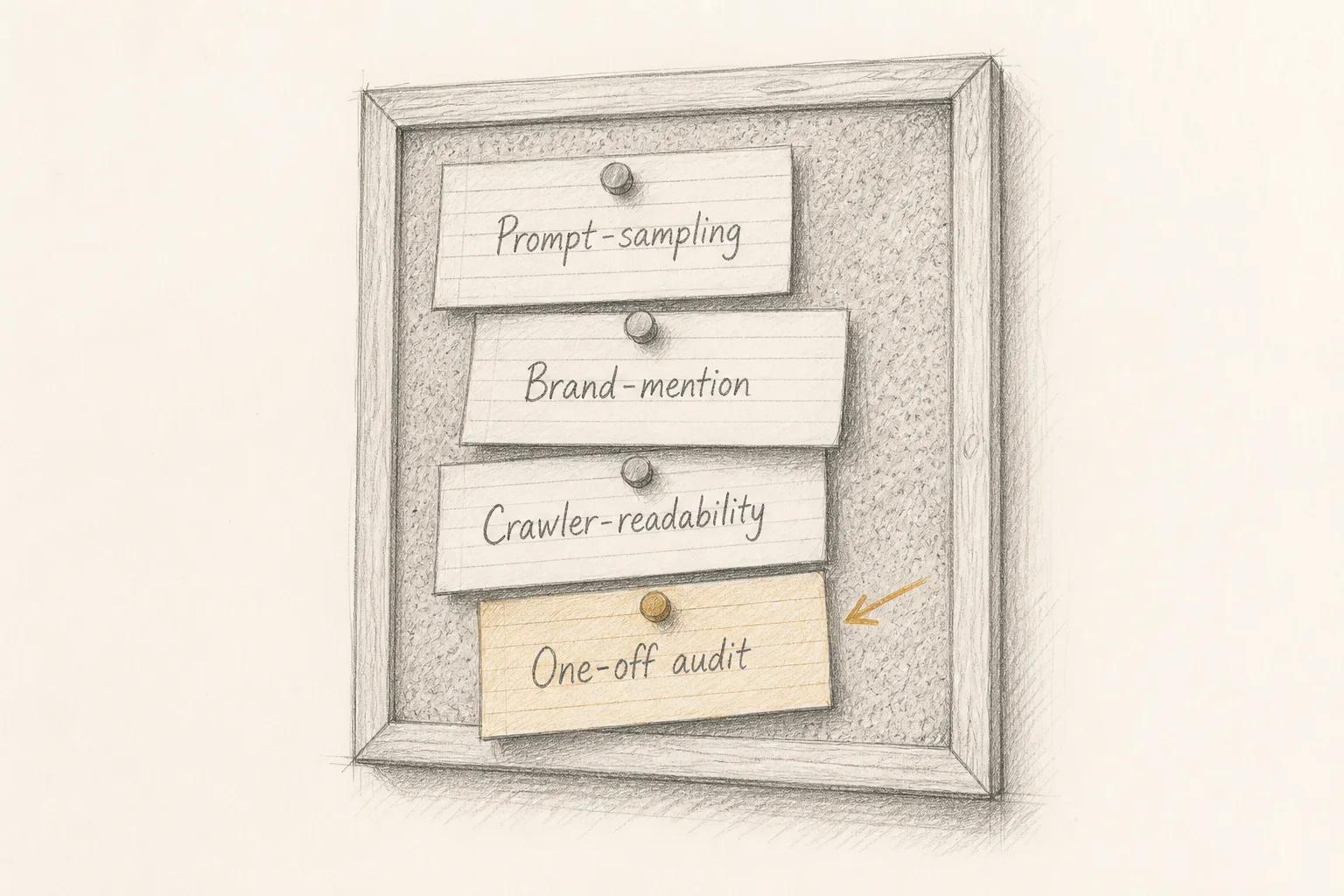
AI Visibility Tools: The Four Things They Measure, and Which Kind You Need
AI visibility tools measure four different things: answer share, brand mentions, crawler readability and one-off audits. Learn what each number counts and who it suits.
 Guide
AI Visibility, Defined: What It Means for Answer Engines to See Your Product
AI visibility is how often answer engines name your product when buyers ask. Learn what is measurable, how to check it, and why nobody can promise a citation.
 Guide
Answer Engine Optimization: What Google Has Actually Said, and What Is Left to Do
Answer engine optimization means being a page AI answers can find, read and cite. Google says it needs no special files or schema. Here is what actually matters.
 Guide
Beyond SEO: The Seven Areas a Full Website Audit Should Cover
A full website audit checks seven areas, not just SEO: search, AI visibility, backlinks, security, compliance, speed and visual, and whether your site works.
 Guide
Catching SEO Regressions After a Deploy: The Checks Worth Re-Running
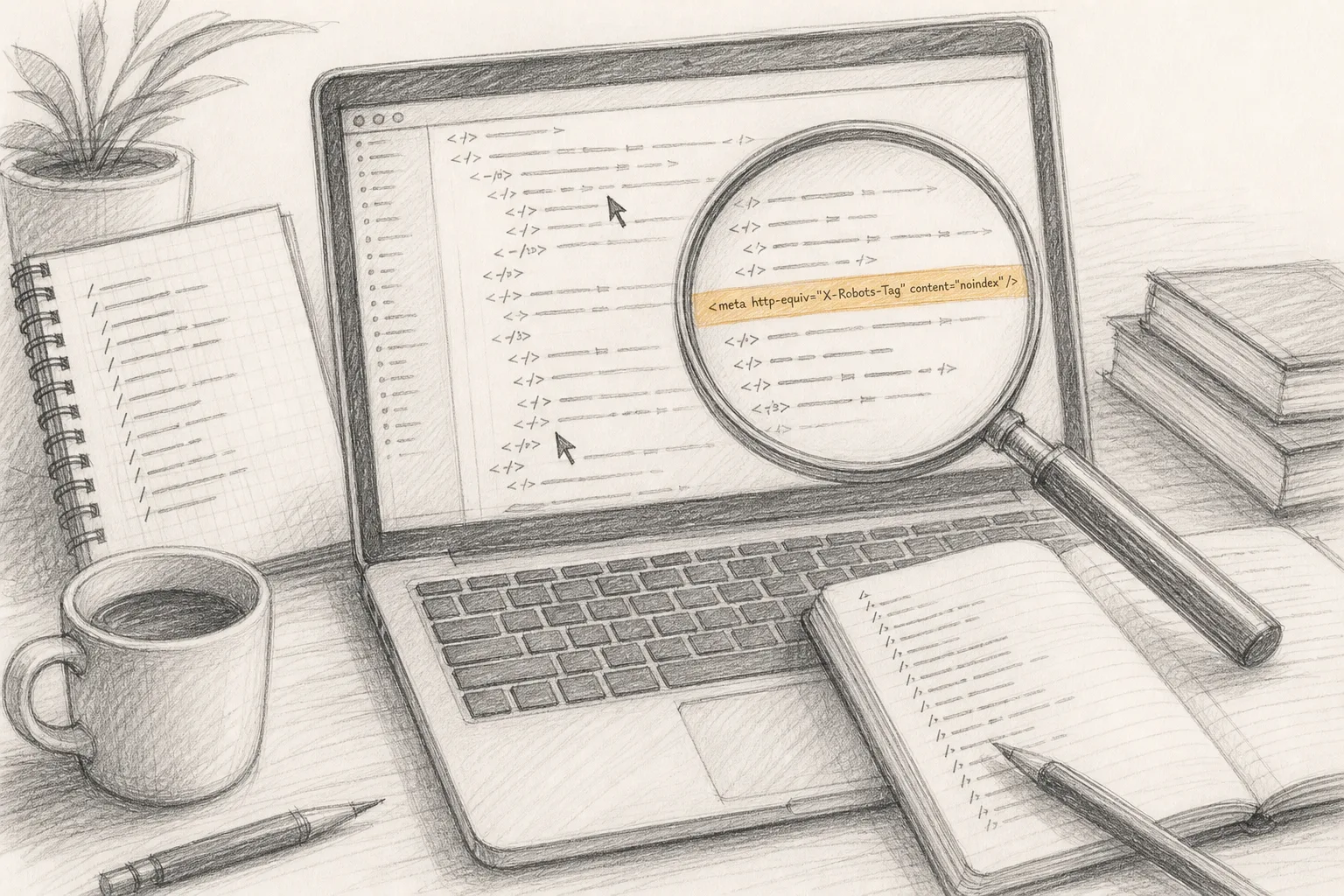
Catch SEO regressions after a deploy: baseline production, then re-check robots.txt, noindex, canonicals, redirects, raw HTML and certificates on every release.
 Guide
Content Marketing and SEO for a One-Product Company: How the Two Actually Meet
Content marketing and SEO are one job for a one-product company: pick questions from Search Console, answer each fully, publish on your own domain. Ten steps.
 Guide
Free SEO Optimization Tools That Read Your Live Site (And What Each One Leaves Out)
The free SEO tools that read your live site: Search Console, Bing Webmaster Tools, PageSpeed Insights, Rich Results Test, a crawler and a readiness scan, in order.
 Guide
Free SEO Scanner: What It Can Tell You, and Exactly Where It Stops
A free SEO scanner checks whether crawlers can reach, read and trust your pages. Here is how to run one, read its evidence, and know where free checks stop.
 Guide
How to Get Backlinks for a SaaS Product: What Works, and What Will Get You Burned
Get backlinks for a new SaaS product from crawled directories, integration pages, curated lists and real guest pitches. Ten steps, and the tactics to refuse.
 Guide
Launching a New Product: The Pre-Launch Checklist to Run First
Launching a new product means release, readiness, announcement and distribution. Here is the timeline, the page checks to pass first, and how to get first users.
 Guide
Paid Placement on Product Directories: What You Are Buying, and What You Are Not
Paid placement on a product directory rents a labelled slot for a set time. It buys attention, not a better verdict or ranking. Ten steps to judge one first.
 Guide
Profound Pricing: What Answer-Engine Tracking Costs, and What a Single Site Needs
Profound sells AEO tracking as a recurring tiered subscription. Learn the five levers that set its cost and whether one site needs continuous tracking at all.
 Guide
Semrush vs Ahrefs: A Factual Side-by-Side for Teams and Single-Site Owners
Semrush vs Ahrefs: both are web-wide SEO subscriptions. Semrush spans wider marketing work, Ahrefs centres on organic search. Here is how to test which fits you.
 Guide
SEO Content Writing for Founders: How to Write the Piece That Answers One Question
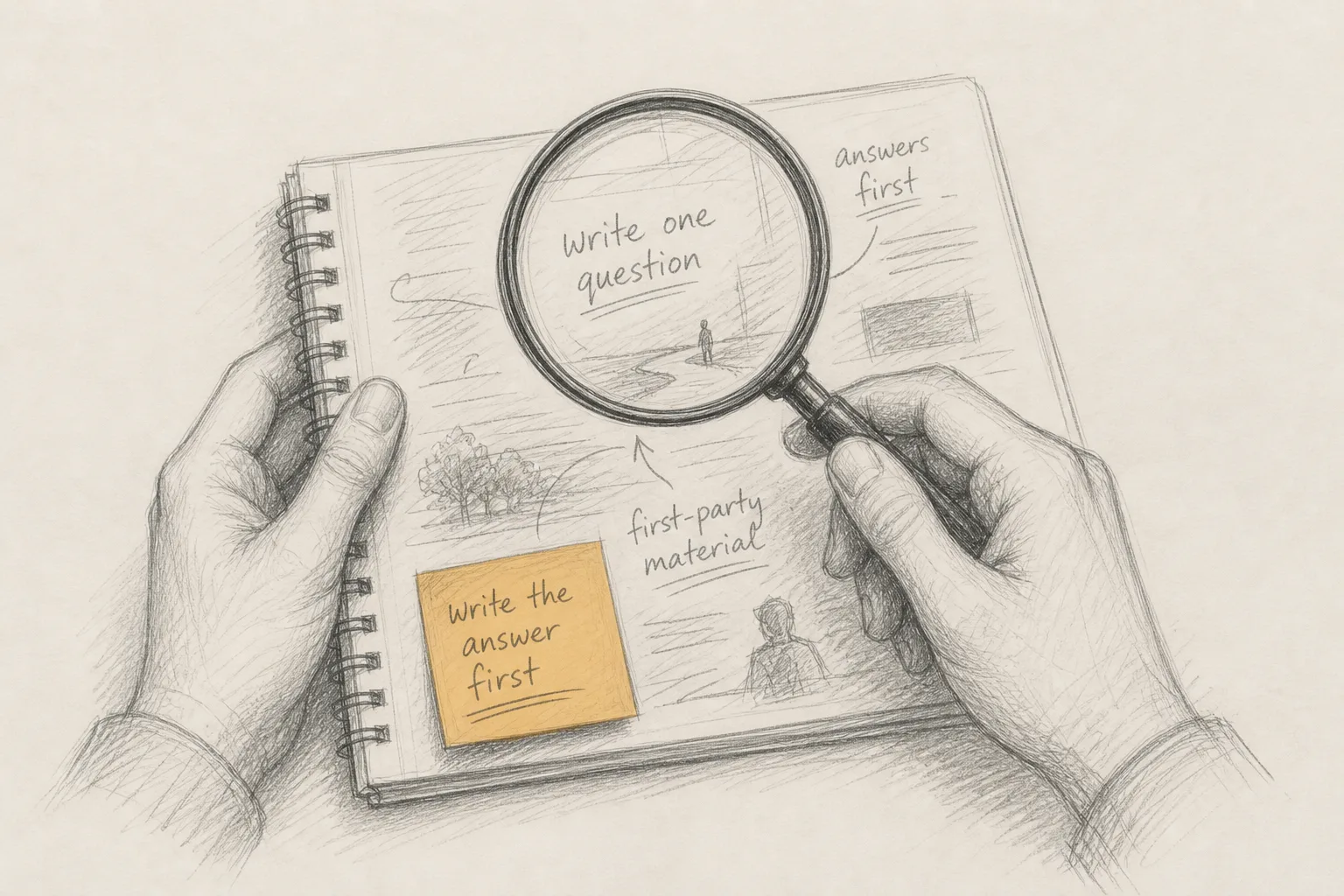
SEO content writing means writing a page that fully answers one question people search for. Ten steps, a worked example, a brief template and Google's self-check.
 Guide
Software Product Review Sites: Where Third-Party Reviews of Your Product Can Live, and What Each Is Worth
Software product review sites come in four kinds: review platforms like G2 and Capterra, maker directories, newsletters and commissioned reviews. Compare them.
 Guide
What a Full SEO Audit Should Contain: Evidence, Fix and Priority for Every Finding
A full SEO audit gives every finding its measured signal, the threshold it failed, evidence from your page and the exact fix, ordered by what breaks first.
 Guide
What Is an SEO Audit? What It Checks, and What a Readiness Scan Adds
An SEO audit inspects your live site for what stops search and answer engines finding, trusting and citing it. See the seven areas, evidence and steps.
 Guide
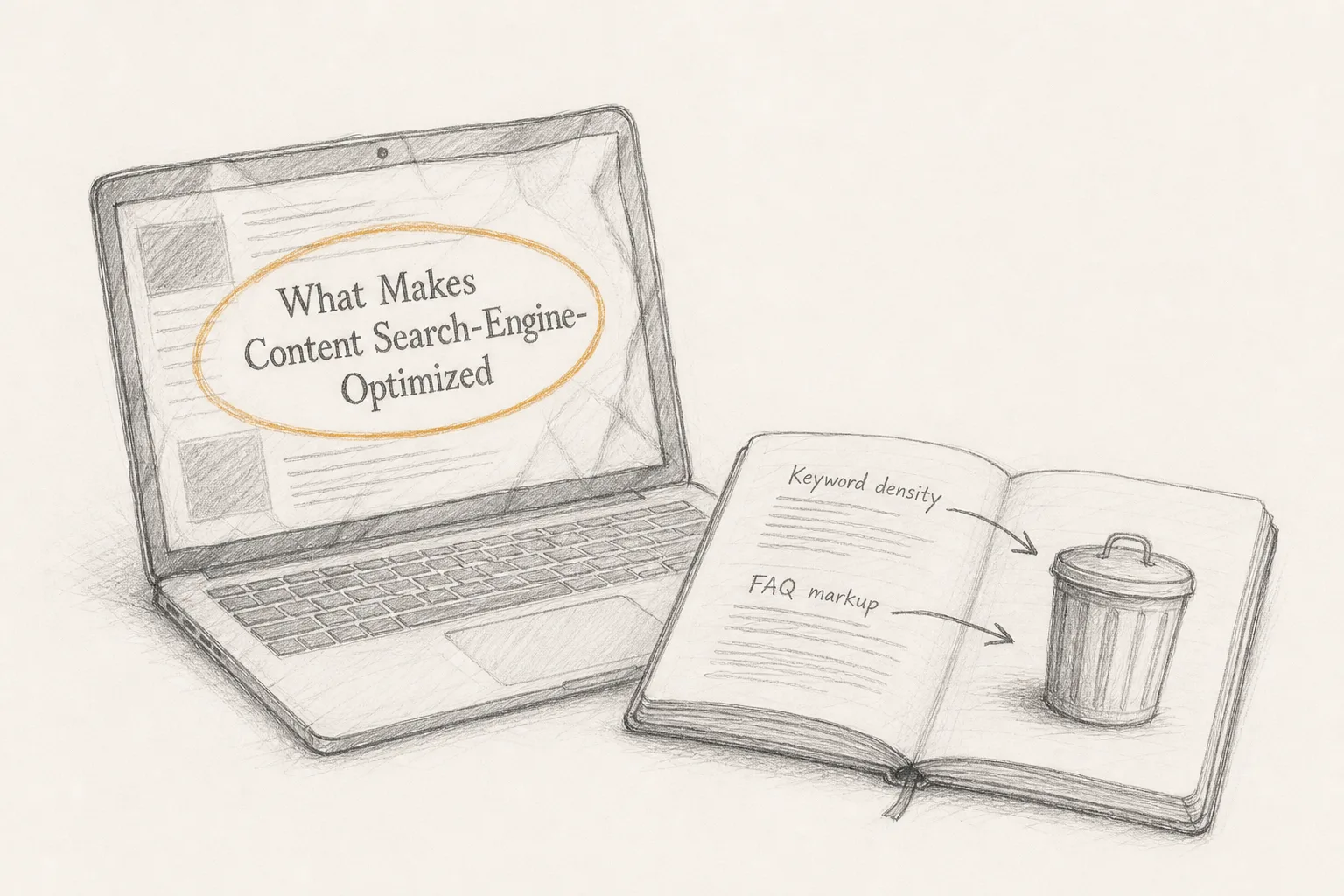
What Makes Content Search-Engine-Optimized in 2026 (And What Stopped Mattering)
Search-engine-optimized content is crawlable server-rendered text, one clear intent, sourced claims and a title that matches the query. The old rules are gone.
 Guide
Where New Product Launches Actually Get Seen Now
New product launches get seen on launch sites, directories, communities and newsletters. Here is what each asks, how long attention lasts and what survives.
 Guide
Why Your New Site Isn't Showing Up on Google: Causes in the Order Worth Checking
Website not showing up on Google? Check causes in order: noindex tags, robots.txt, orphan pages, JavaScript-only content and uncrawled URLs, with a fix for each.
Newsletter
What launched, every Monday
Every Monday: what launched on LaunchScaler that week, what is launching next, and the reviews we published. Confirm your email once and you're in.