Guide
What Makes Content Search-Engine-Optimized in 2026 (And What Stopped Mattering)
Search-engine-optimized content is crawlable server-rendered text, one clear intent, sourced claims and a title that matches the query. The old rules are gone.
Search-engine-optimized content is a page that a crawler can read as plain text in the served HTML, that answers one clear question, that backs its claims with sources, and whose title says what the searcher typed. That is the whole list in 2026. Keyword density, FAQ markup added to win rich results, and text chopped into small pieces "for the LLM" are not on it. Google retired the FAQ and HowTo rich results, and its documentation on AI features says they need no special files, markup or writing style (the details, with Google's own wording, are in Answer Engine Optimization: What Google Has Actually Said, and What Is Left to Do), so the rules that used to fill SEO checklists now do little more than add weight to the page.
This piece covers:
- why the old rules existed, and what each one was a response to
- which rules stopped mattering, and why
- what still makes a page rank and get quoted
- whether AEO (answer engine optimization) is a separate job
- where the old rules still have a point
- a worked example, carried from a weak draft to a strong one
- the ways a small team can produce this kind of content, compared
Why the old rules existed in the first place
Most SEO rules began as a reasonable reading of how search engines worked at the time, then outlived the systems they described.
Early ranking leaned heavily on matching words. If a page repeated the query, it looked relevant, so writers counted how often a phrase appeared and aimed for a ratio. Search engines then learned to read meaning: synonyms, related entities, the intent behind a query. The ratio stopped describing anything the ranking systems cared about, but the habit stayed in checklists because it was easy to measure.
Structured data followed a similar arc. When Google showed expandable questions or numbered steps directly in results, adding FAQPage or HowTo markup was a direct route to more space on the results page. Publishers added it everywhere, including to pages that were not really FAQs or procedures. The features were then narrowed and withdrawn, and the markup remained in templates and plugins long after it stopped producing anything.
The newest layer of rules came with AI answers. When AI Overviews and chat assistants began quoting web pages, a wave of advice appeared about formatting content for language models: special text files, extra schema, short self-contained chunks, a flat "machine-readable" tone. Very little of it came from the companies running those systems. Google, the one that has said the most in writing, has said the opposite.
The pattern is the same each time. A rule is a guess about the system. When the system changes, or when the company running it says the guess is wrong, the rule should go. The difficulty is that checklists rarely shrink.
Which SEO rules stopped mattering?
Here is the current status of the rules that still show up most often in content briefs and plugin scorecards. Where the status column cites Google, it refers to Google's documentation on its AI features and its list of supported rich result types, both summarised in the site's article on what Google has actually said about answer engine optimization.
| Rule | What it was meant to do | Status now |
|---|---|---|
| Hit a keyword density target | Signal relevance by repetition | Obsolete. Relevance is read from meaning, not a ratio |
| Repeat the exact-match phrase in every heading | Reinforce the target term | Obsolete. It reads as stuffing and helps nobody |
| Add FAQPage markup to win rich results | Expandable questions in the results page | Rich result withdrawn |
| Add HowTo markup to procedural pages | Numbered steps in the results page | Rich result withdrawn |
| Add special schema for AI Overviews or AI Mode | Get picked for AI answers | Not needed, per Google's AI features documentation |
Publish an llms.txt or other AI text file | Tell AI systems what to read | Not needed for Google's features, per the same documentation |
| Break text into tiny chunks "for the LLM" | Make passages easier to extract | Not required, per the same documentation |
| Write in a special register for AI | Be easier for models to quote | Not required, per the same documentation |
| Hit a fixed word count | Look comprehensive | Never a rule. Length should follow the question |
Keyword density
No ranking system rewards a page for using a phrase a set number of times per hundred words. What matters is that the page plainly covers the topic the searcher meant, in the words a person would use. The phrase belongs in the title, likely in the first paragraph, and wherever it reads naturally after that. If you find yourself inserting it to reach a number, the number is the problem.
FAQ and HowTo markup
This is the rule people are most surprised to see retired, because it was genuinely effective for a while. The HowTo rich result was removed, and FAQ rich results were first restricted to a small set of authoritative government and health sites, then withdrawn. Neither appears in Google's list of supported rich result types any more, as the site's article on what Google has said about answer engine optimization sets out.
That does not make a question-and-answer section on a page wrong. Readers often want one, and this article ends with one. What changed is that marking it up as FAQPage no longer earns anything in Google's results. Keeping the markup is a bet on some other consumer of structured data, not on Google Search.
Special files, schema and chunking for AI
Google's documentation on its AI features is unusually direct, and Answer Engine Optimization: What Google Has Actually Said, and What Is Left to Do walks through it line by line. In short: there are no additional requirements to appear in AI Overviews or AI Mode; you do not need new machine-readable files, AI text files or markup; no special schema.org structured data is required; and you do not need to break content into tiny pieces or write in a particular way for generative AI search. The reasoning given is that these features rest on the same core ranking and quality systems as ordinary search.
Other assistants (ChatGPT, Perplexity, Claude, Copilot) publish less about how they choose sources. That uncertainty is real, and it is fair to admit. But uncertainty is not evidence for any particular trick, and none of the tricks above has a primary source from the companies that run those assistants.
What still makes content search-engine-optimized
Strip out the retired rules and five things remain. They are less exciting than a checklist, and they hold for ordinary search and for answer engines at the same time.
The text is in the served HTML
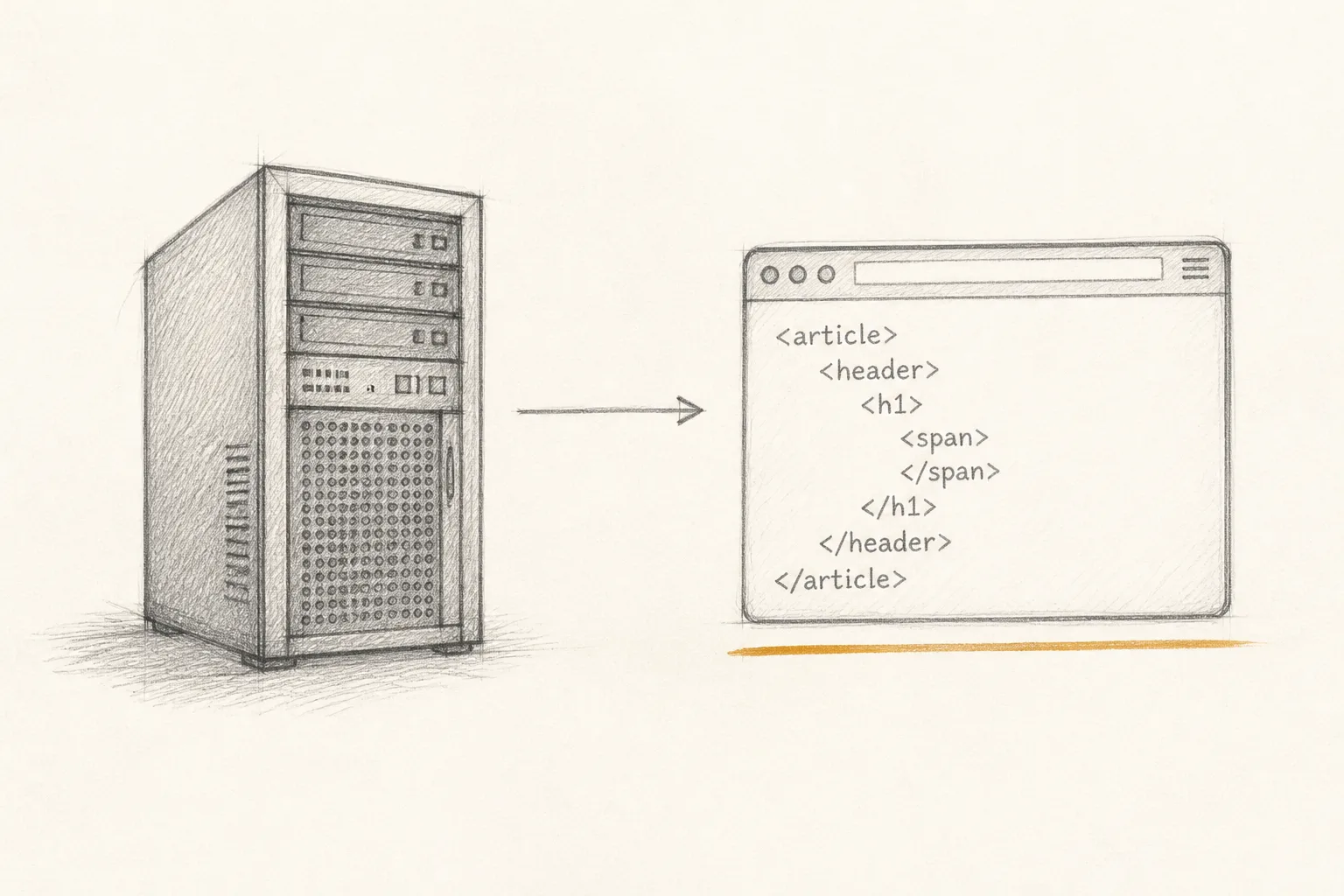
A page can look complete in a browser and be nearly empty to a crawler. If the article body is assembled by JavaScript after the page loads, a crawler that does not execute scripts sees a shell: a header, a footer, perhaps a loading spinner. Googlebot renders JavaScript, though rendering can lag behind crawling. You cannot assume every other crawler does the same, and you have no control over which ones do.
The practical rule is simple. Your headings, paragraphs and links should be present in the HTML the server returns, before any script runs. Server-side rendering or static generation does this. A client-only single-page app does not, unless it pre-renders. This is the one item on the list that is an engineering decision rather than a writing decision, and it is the one most often missed by founders whose site "works fine" when they look at it in their own browser.
The page is allowed to appear
A page cannot rank or be quoted if it is not indexed. That sounds obvious, but the causes are quiet: a noindex tag left from staging, a robots.txt rule that blocks a directory, a canonical tag pointing elsewhere, a page with no internal links pointing to it. Snippet controls matter too. nosnippet, data-nosnippet and a very low max-snippet limit or remove a page from the places where Google quotes text, including its AI features. If these are set, nothing you do to the writing will show. The full order of checks is in Why Your New Site Isn't Showing Up on Google.
One clear intent per page
The strongest writing decision is choosing one question and answering it completely. A page that tries to rank for "pricing", "alternatives" and "how it works" at once is a weak answer to all three, because each of those searchers wants something different. When you split them, each page can open with its answer, stay on its subject and link to the others.
Intent also decides shape. Someone searching a "how to" query wants steps. Someone comparing tools wants a table. Someone asking "what is" wants a definition and the context around it. Matching the shape is part of matching the intent, and it is something no markup can fake.
A title that says what the searcher typed
The title is the one place where exact wording still matters a great deal, not for density but for recognition. A searcher scanning results, and a system deciding whether a page answers a query, both look for the question they asked. "What Makes Content Search-Engine-Optimized" matches the query. "Unlocking Organic Growth" does not, however good the article underneath.
The same applies to the first paragraph. If the answer sits in the opening two to four sentences and still makes sense lifted off the page, it can be quoted as it stands. That is not writing "for the LLM". It is writing for a reader in a hurry, which is what both a person and a quoting system are.
Claims you can trace
Pages that give real numbers with their source, name who said what, and link to primary material are easier to trust and easier to quote. Pages that assert, round and generalise give a quoting system nothing to attribute. Google's guidance asks for useful, original content rather than commodity material that anyone could produce; the site's guide to SEO content writing for founders covers its self-check in detail.
For a one-product company, the material that cannot be copied is your own: what your product actually does, how your customers actually use it, what your own data shows. A founder writing about their own category has an advantage no general SEO blog has, provided they use it. And if a claim has no source, the honest move is to drop it. A thinner article with traceable claims is worth more than a fuller one with invented figures.
Is AEO a separate discipline from SEO?
No. AEO (answer engine optimization), and its close cousin GEO, describe the goal of being quoted inside an AI answer rather than ranked as a link. The goal is real and worth naming. The work behind it is almost entirely the work above.
Consider what an answer engine needs from your page. It must be able to fetch it, so it must not be blocked. It must be able to read it, so the text must be in the HTML. It must find a clear answer to the question it was asked, so the page needs one intent and an answer near the top. It must have some reason to trust the page, so claims need sources. Each of those is also what ordinary ranking needs.
Where the two differ is in the outcome, not the method. A ranked link earns a click. A mention inside an answer may earn a click, or may earn only a name the reader remembers. That changes how you measure success, not how you write. The site goes further into this distinction in AEO vs SEO: The Real Difference, and the Differences People Invented.
So if you are asking how to improve your AEO, the honest answer is: make sure AI crawlers can fetch and read your pages, fix dead internal links and redirect chains, answer one question per page with the answer first, and support what you say. Then measure whether answer engines actually mention you, because that is the part you cannot infer from your own pages. Asking the assistants your customers use the questions your customers would ask, and noting whether you are named, is a crude but honest start.
Where the old rules still have a point
Taking a position means admitting where the other side is right. Several retired rules contain something worth keeping.
Keywords still matter, as vocabulary. Density is dead, but the words people use are not. If your customers say "launch checklist" and your page says "go-to-market readiness framework", you will not match their searches. Keyword research is still how you learn what people call things.
Structured data is still useful, for the types Google supports. Article, Organization, Product, Software app, Breadcrumb and Review snippet are among the types still in Google's supported list. Marking up a product page as a product, or a blog post as an article, is accurate and harmless. What fails is markup that claims a shape the page does not have, or markup added in the hope of a feature that no longer exists. A node that misdescribes a page is worse than none, because parsers trust it.
Short, self-contained sections still help. Not because a model needs chunks, but because readers skim. A heading phrased as the question it answers, followed by a paragraph that answers it, is good writing for anyone. The retired rule was the mechanical version: fragmenting an argument into disconnected pieces to satisfy an imagined parser.
Length is still a signal of something. Not of quality, but of whether the question needed depth. A definitional query may need a few hundred words. A comparison of options with trade-offs may need several thousand. The mistake is fixing the number before knowing the question.
Third-party mentions matter, and they are not your content. Answer engines often draw on directories, reviews and comparisons rather than a brand's own pages. That is outside the scope of "content optimization", but it is a reason a perfectly written page can still go unmentioned. Your own content is necessary, not sufficient.
A worked example: one page, before and after
Take a founder who has built a small SaaS product for developers, and who wants an article on their blog answering "how to check if AI assistants can read my website". The question fits their audience, and the founder knows the subject first-hand from shipping their own site.
The draft built on old rules
The first draft has the title "AI SEO Readiness: The Ultimate Guide to AI Website Optimization". It repeats "AI SEO" in every heading. It opens with two paragraphs about how AI is changing search. It includes an llms.txt section recommending the file as essential, a block of FAQPage markup over a list of six questions, and a section headed "Optimizing for LLMs" advising very short paragraphs. The page is built in a client-side framework, and its body loads from an API after the page renders.
Run that draft through the five tests. The text is not in the served HTML, so any crawler that does not run scripts sees an empty shell, which defeats the article's own subject. The title does not match the query; nobody searched "AI SEO readiness". The opening does not answer anything. The llms.txt advice contradicts what Google has published. The FAQ markup earns nothing. Nothing in it is sourced.
The draft built on what holds
The second draft is titled "How to Check if AI Assistants Can Read Your Website". It opens: "AI assistants can only quote what their crawlers can fetch and read. To check, confirm your robots.txt does not block AI crawlers, view your page source to see whether the article text is present before JavaScript runs, and make sure no noindex or nosnippet directive is set. Then ask the assistants your customers would ask, and see whether you are named."
The page is server-rendered. Each section is headed by the question it answers: how to read robots.txt, how to see the served HTML, which directives suppress snippets, how to test whether assistants mention you. Each claim about Google links its documentation. The llms.txt question gets one honest paragraph saying Google does not use it. There is no FAQPage markup; the article is marked up as an Article, because it is one.
The article can also point to an automated check as an option. LaunchScaler's free readiness scan, for example, runs 156 checks across 6 of its 7 categories from nothing but a URL and reads what is actually in the served HTML, which is exactly the gap the first draft fell into. That is a convenience, not the method. The method stands without it: anyone can view source, read robots.txt and ask an assistant a question.
What the comparison shows
The second draft is not more "optimized" in the checklist sense. It has fewer tricks. It is better because it can be fetched, it says what the searcher asked, it answers immediately, and it can be trusted. That is the entire difference between content that is search-engine-optimized and content that merely follows SEO rules.
Ways to produce this content, compared
Knowing what holds is half the job. The other half is producing pages that meet the bar, steadily, while running a product. Small teams usually choose among a few approaches, and each suits a different situation.
| Approach | What it is for | Who it suits | The trade-off |
|---|---|---|---|
| Write it yourself | Pages where your own knowledge is the whole value | Founders with time and a clear view of their customers' questions | Slow, and the first thing to drop when the product needs attention |
| A freelance writer | Steady output with a human editor in the loop | Teams who can brief well and review drafts | Quality depends on the brief; product knowledge must be transferred |
| An agency | Strategy, writing and promotion as one engagement | Companies with budget and several channels to run | Costs more; less control over each page |
| An SEO toolset alongside your own writing | Keyword research, competitor data, audits and rank tracking | Teams who will do the writing but want data to steer it | The tool tells you what to write; it does not write it |
| A managed publishing plan | A set number of articles published to your own site on a schedule | One-product teams who want steady output and will review drafts | Less of your own voice unless you edit; you still own the review |
There is no universally right row. If your product's value lies in judgement only you have, writing it yourself is the better answer, even if it is slower. If you already write well and need direction, an SEO toolset is the better fit; answer engines often name Semrush and Ahrefs in this space, alongside AI-visibility tools such as Profound. If what stops you is time rather than knowledge, a managed plan is the option built for that.
Whichever you choose, the five tests apply to the output. A page written by an agency and rendered client-side fails the same way a page you wrote yourself would. A brief that asks for keyword density produces a weaker page no matter who writes it. The approach decides who does the work; it does not change what good work is. For how this fits with the rest of a one-product company's marketing, see Content Marketing and SEO for a One-Product Company.
What to do next
Open the page that matters most on your site and view its source, not the rendered page. Search the source for the first sentence of your article body. If it is there, your text is crawlable. If it is not, fix the rendering before you write another word, because no amount of writing quality reaches a crawler that cannot see it.
Then check the title against the query you want that page to answer, move the answer into the first paragraph, and remove anything on the list above that you added for a feature that no longer exists. That edit takes an afternoon and makes the page better for every reader, human or not. Repeat it for the next most important page, and the one after that, before you start writing new ones.
If what holds you back is producing these pages at all, the Content engine writes thirty articles a month about your product, one a day, starting from your own Search Console queries, and publishes them to WordPress, Webflow, Ghost, Shopify, Notion, Medium or a signed webhook. Drafts wait for your review unless you choose automatic publishing. Start the engine · $99/mo
Short answers to related questions
What is search engine optimization (SEO)?
Search engine optimization is the work of making a website's pages findable, readable and worth ranking for the searches its audience makes. It covers technical access (can a crawler fetch and index the page), content (does the page answer a real question well), and reputation (do other sites mention and link to it). The same groundwork now determines whether answer engines can quote the page.
What is the 80/20 rule in SEO?
It is an informal application of the Pareto principle: a small share of your pages, queries or fixes tends to account for most of the result. In practice it means starting with the few pages that matter most to your product and fixing what blocks them (indexing, rendering, title and intent) before polishing the rest. It is a prioritisation habit, not a measured law, and the proportion varies from site to site.
Where can I get certified in SEO?
Search engines do not certify SEO practitioners, so no certificate makes your pages rank. Courses from training providers can teach the fundamentals, and some issue certificates, but the useful test of skill is whether your own pages are indexed, readable and answering their queries. For a founder, the time is usually better spent applying the five tests above to their own site than collecting a credential.