Reply Argus review: grounded, approval-gated replies to every App Store and Google Play review
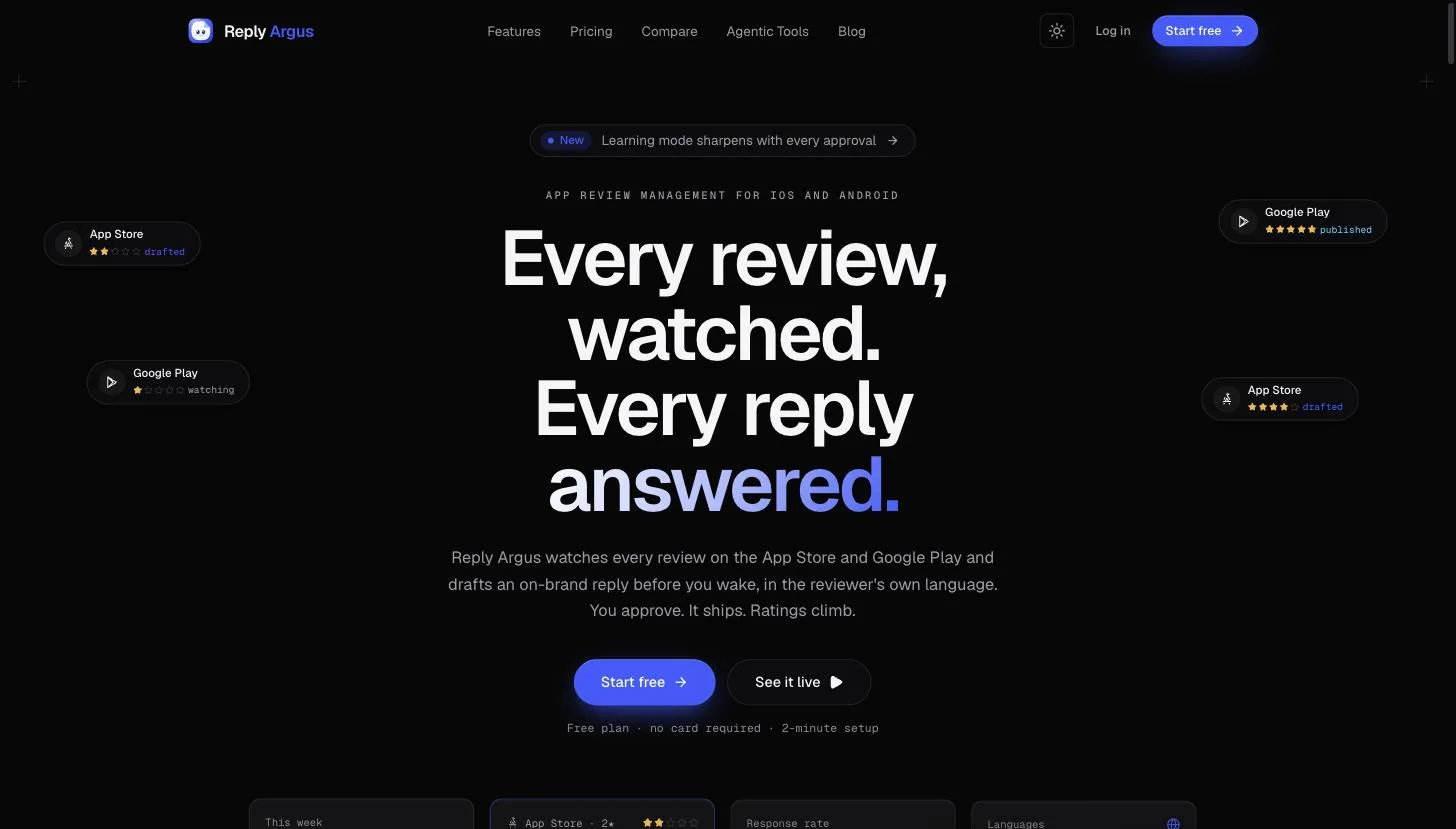
Reply Argus watches every App Store and Google Play review, drafts an on-brand reply in the reviewer's language from a per-app knowledge base, and publishes only what you approve. A free plan answers 100 reviews a month; the knowledge base and ranked feature requests start at $29.
AI-powered app review management for the App Store and Google Play
Review
Reply Argus asked for this review and paid for the write-up. Joel, who wrote it, also runs Reply Argus. The verdict is ours, and so is the rating.
We read Reply Argus's home, pricing and features pages, its open benchmark of app reply rates, its developer API and MCP pages, and its security, alternatives, agencies, about and store-rules reference pages, on September 17, 2026. Every price and limit below comes from those pages.
Reply Argus is an app review management tool for iOS and Android developers. It connects to App Store Connect and Google Play, pulls every review from both stores into one inbox, and drafts an on-brand reply in the reviewer's own language, grounded in a per-app knowledge base on paid plans. Solo developers, portfolio developers, small support teams and the agencies that run reviews for clients are who it is built for. Starting costs nothing: 100 replies a month on one active app, no card required. The knowledge base and ranked feature requests arrive at $29 a month, automation rules and the REST API at $79. One constraint up front: it covers exactly two stores, the App Store and Google Play.
The evidence that most apps never reply
Picture a one-star review landing on a Tuesday night, in Portuguese, while the developer sleeps. In the field as actually measured, 99% of the replies that ever arrive come within seven days, and the curve goes flat after a week, so by the following Tuesday that review's fate is settled: it will never be answered.
The measurement is Reply Argus's own, published as an open benchmark of app reply rates and collected July 26, 2026: 36 major apps, 10,800 public Google Play reviews, a method written out so anyone can reproduce it. The median app answers 1.2% of its reviews. Fifteen of the 36 answered none. When apps do answer they answer fast, a median of six hours, and only 6 of 36 cleared fifty percent. Replying is not something companies do a little of: they either treat it as a channel or ignore it completely.
Averaged across every review, the rate reads kinder, 18.3%, because a handful of apps reply to nearly everything: Booking.com at 97.7%, MyFitnessPal at 96.7%, Todoist at 93.3%. The distance between that average and the 1.2% median is the whole story of this market, and it is the gap a tool like this exists to close.
Pooled across all 36 apps, here is which reviews get answered:
Review rating
Reply rate
Reviews in sample
1 star
25.4%
3,007
2 star
27.0%
638
3 star
27.9%
599
4 star
21.9%
855
5 star
12.1%
5,701
The field answers its angriest customers most often and its happiest least, and the happiest are by far the biggest pool: 5,701 five-star reviews against 3,007 one-stars. The people who took time to praise an app are the people most likely to hear nothing back.
The benchmark is also unusually honest about its own limits, which matters if you are going to trust a dashboard from the same vendor. It points to AppFollow's June 2026 study of 51.5 million reviews across 22,800 apps and says that where the two disagree, prefer the bigger one. It notes that Appbot's still-quoted 97% unanswered figure dates from November 2016 and was never updated. It lists the five apps it excluded, Spotify, Instagram, TikTok, WhatsApp and Wise, with the reason for each. And it concedes it measures effort, not quality: a canned line pasted onto three hundred reviews scores the same as a considered answer.
The companion reference on what Apple and Google actually document about replies settles the question every buyer asks eventually: neither store claims that replying raises your rating or your ranking. The site's own guide puts the case in one line. Replying is worth doing because it changes what a real person does next, not because a store rewards it.
Screens from Reply Argus
How it works, from review to reply
Connect App Store Connect and Google Play once and the watch runs itself. The name is the brief: Argus Panoptes, the watchman of Greek myth, had a hundred eyes and never slept. What actually happens to a review is a loop with four stages, each named in the dashboard:
App Store ----\
               +--> ONE INBOX ----> TAGGED ----> ARGUS DRAFTS ----> YOU APPROVE, or a
Google Play --/    New / Drafted /   rating,      a grounded reply    rule you trust
                   Published /       language and in the reviewer's  publishes it
                   Skipped           sentiment    own language
                                                       |
                                                       v
                                       SIGNAL: recurring asks clustered,
                                       ranked by what to fix first
The feed sorts everything into four states: New (arrived, nothing drafted yet), Drafted (a reply is written and waiting on you), Published (live on the store) and Skipped (set aside). The watch-log demo shows the same stream with timestamps in minutes: an English logout complaint drafted at +00:03, a German crash report marked Watching at +00:11, a Japanese review published at +00:22.
Where a draft gets its facts
The drafting engine, which the site consistently calls Argus, builds every reply from two ingredients: your past approved replies, which supply the voice, and a per-app knowledge base, which supplies the facts. The knowledge base assembles itself:
Source
How it arrives
What Argus does with it
App Store listing
Pulled in automatically on connect
Learned per platform, citable in drafts
Newsletter
What launched, every Monday
Every Monday: what launched on LaunchScaler that week, what is launching next, and the reviews we published. Confirm your email once and you're in.
Open any draft and the exact notes and listing lines it drew from sit quoted beside it, as you wrote them, with a flag when two sources looked contradictory. The per-platform separation is the detail worth pausing on: an Android reply cites the Play listing, not the iOS one, so a fact that is true on one store and stale on the other cannot leak across. Brand facts sit on top. Set your support email, your refund or help link and the lines you never want said once, and every reply across every app honors them, so a draft cannot invent a refund policy. Mark a cited fact right or wrong as you review, and Argus leans harder on what you confirm and stops repeating what you reject.
Every edit teaches the style, and on Pro and up a Learning mode sharpens with every approval. Tune a voice once, save it as a named profile and apply it to any app in a click, so a portfolio can share one tone without re-tuning each app. Per app you also pick from four tones the product names: concise, warm, neutral or playful.
Language handling is the capability the site leads with everywhere. Argus reads each review in the language it was written and replies in that same language, 100+ of them, tone intact, no copy-paste translator in the loop. Pro adds auto-translate, and the MCP toolkit has a translate_review tool that turns a review into your own language before you respond.
A find-similar feature clusters every review echoing the same complaint, with a match score, so one considered reply can cover a hundred variants of it. The analytics side refuses to be a wall of charts: rating trend and response rate sit at the top, and beneath them an AI executive summary names the themes moving the number. The sample readout on the features tour reads: visible rating held at 4.3, two themes drove 61% of the month's 1 and 2 star reviews (a session bug after version 4.1, down 40% since 4.1.2 shipped, and Android onboarding friction), praise for the redesign up 22%, 92% of reviews answered. It is a paragraph a human analyst would write, refreshed as reviews land.
Alerts ride on top of all this. Connect Slack, Telegram, Discord, email or a webhook, and Argus watches each app's last 24 hours against a 28-day baseline, pinging the moment a rating crashes or negative reviews spike, with a cooldown so an ongoing dip never storms your channels. There are no thresholds to set. Drafting cadence is yours too: per app, off, daily or hourly, with reviews syncable on demand and monitoring toggleable per app.
Signal: your reviews, ranked by what to fix
Signal is the feature that turns the product from an answerer into an analyst. Once at least a few reviews ask for the same thing, Argus groups them into one card, scored High, Med or Low by how many reviews back it and how it trends, every entry linked to the reviews behind it. The example feed shows the shape: dark mode for the reader, 23 reviews, rating 2.1 and rising, ranked High; offline reading sync, 11 reviews, 3.4 and steady, ranked Med; a resizable home widget, 4 reviews, 3.9 and new, ranked Low.
Nothing in the feed is invented: every card is backed by real reviewers. An entry pushes one-way to Notion or Google Sheets, or downloads as CSV, Markdown or JSON, with Jira and DevRev marked coming soon. The site is explicit about the shape of this: "It's a clean handoff into your workflow, not a two-way sync to babysit." Signal is included from Indie up, and the file downloads are free on any plan. A team whose planning lives in Jira today takes the CSV and waits for the connector.
The approval gate, and why the stores make it necessary
Approval mode is on when you start: Argus drafts, you approve. Auto-publish is always opt-in and off by default. The Free plan pairs manual approval with an opt-in 5-star auto-publish, Indie broadens that to autonomous auto-publish, and Pro adds the rules engine, with triggers on rating, keyword, language or store.
The gate matters more than it sounds, and the stores' own rules are why. Both stores allow exactly one public reply per review. On Google Play you can edit a reply at any time, but no deletion mechanism is documented, and the Reviews resource exposes only get, list and reply: as documented, a Play reply is editable forever but not removable. On the App Store you can edit and delete, and a reply can take up to 24 hours to appear, a state the API exposes as PENDING_PUBLISH versus PUBLISHED. A bad reply on Android is therefore a semi-permanent public object attached to your product page, and you get one shot per review. An approval-first design is the only sane answer to those rules.
The reference, sources checked July 26, 2026, answers the questions teams argue about, with a vendor quote beside every answer:
Question
App Store
Google Play
How long can a reply be?
Not documented; the 5,970 and 10,240 figures in circulation appear in nothing Apple publishes
About 350 characters, per the reviews.reply API reference
Replies per review
One
One; a new reply updates the existing one
Edit or delete
Edit and delete, no documented window
Edit any time; no delete method exists
Is the reviewer notified?
Yes, and they can update their review
Yes, by push notification and email
Time until visible
Up to 24 hours
Not documented
Who may reply
Account Holder, Admin or Customer Support
Anyone with the Reply to reviews permission
Two rows explain a lot of silent consoles. Neither store's API returns ratings that have no written review: Google says so in one sentence, Apple never says it at all, which is why an API count comes back far below the dashboard rating count. And the App Store withholds the reply button from the App Manager role, the one most team members hold, so the person watching the reviews assumes the button is missing rather than withheld. Reply Argus drafts inside the limits this reference documents, including Google's roughly 350-character ceiling, and points to a free character counter built against that documented limit.
The risk register gets one more line. Google's comment posting policy calls the reply feature a privilege rather than a right, and failing to follow the guidelines can suspend an app or a developer account. The one documented consequence of replying badly is punitive, on the store that publishes your reply forever.
Prices are monthly billing; annual takes two months free on every paid tier. Every paid tier opens with a 10-day trial: you add a card to begin, nothing is charged until day 10, and cancelling before then costs nothing.
Overage is designed out. Adding an app is always free; what a tier counts is active apps, the ones auto-drafting and publishing, and a disabled app costs nothing to keep connected. Extra active-app slots run about $12 per app per month, and reply top-up packs are prepaid, opt-in, never expire, roll over and are drawn only after the monthly allowance, so there is no surprise bill. Upgrades apply immediately, downgrades land at the end of the cycle, and reply counts prorate.
What each tier actually buys:
Capability
Free
Indie
Pro
Studio
Basic replies, both stores, 100+ languages
Yes
Yes
Yes
Yes
Manual approval, opt-in 5-star auto-publish
Yes
Yes
Yes
Yes
Knowledge base, cited facts, contradiction flags
Yes
Yes
Yes
Signal, ranked feature requests
Yes
Yes
Yes
Brand voice, brand facts, voice profiles
Yes
Yes
Yes
Instant alerts, rating-drop detection
Yes
Yes
Yes
Automation rules, auto-translate
Yes
Yes
REST API, signed webhooks, Learning mode
Yes
Yes
White-label, roll-up analytics, priority support
Yes
The pattern across the columns is plain: Free proves the drafting, Indie buys the grounding, Pro buys the machinery, Studio buys the agency surface. The reply economics slope the same way. $29 across 300 replies is roughly ten cents a reply, $79 across 2,000 about four cents, $299 across 8,000 under four.
Seats bundled, scoped per app
Five roles carry the workspace:
Role
Power
Who it is for
Owner
Everything including billing; exactly one, transfers only on purpose
The principal
Admin
Runs the whole workspace, never sees the plan or invoice
The ops lead
Publisher
Drafts and publishes
Whoever owns a client end to end
Drafter
Drafts only; nothing goes live without a Publisher or Admin
Juniors, VAs, contractors
Viewer
Read-only, free, never uses a seat
Clients and stakeholders
Scoping is per app, per person, so a Drafter on your fitness client never sees your finance client, "no shared inbox, no accidental crossover, no awkward NDA conversation." The AI connector is Owner and Admin only, which closes a quiet hole: a contractor can never point an outside agent at your workspace.
Seats come bundled rather than sold, 1 on Free, 5 on Indie, 10 on Pro, 25 on Studio, unlimited on Enterprise, with Viewers free and uncapped everywhere. For an agency the arithmetic matters: the bill tracks the replies you ship, not the heads it takes to ship them, and a client watching along costs nothing. Studio adds white-label, your logo, product name and sending domain, each client app isolated with its own voice, rules and knowledge, plus roll-up analytics across the portfolio. The agency guide walks the whole setup.
The developer surface: two reads, six events, twenty-one tools
The REST API, on Pro and up, is deliberately small. Two endpoints, both listed in the API docs: GET /api/v1/apps returns every app in the workspace with name, publisher, platforms, current rating and review total; GET /api/v1/reviews pages your reviews newest first, each with its reply embedded, filterable by app, on a keyset cursor so pulling the whole history causes no offset drift. Keys are read-only, workspace-scoped, minted by an admin, shown once and revocable anytime.
Webhooks cover the events a pipeline wants:
Event
Fires when
review.created
A new review lands on one of your apps
draft.created
A reply is drafted and waiting for approval
reply.published
A reply goes live on the store
digest.weekly
The weekly rollup for an app is ready
anomaly.detected
A rating drop or review spike trips an alert
test
A ping you fire to verify your endpoint
Every POST carries an HMAC signature derived from a per-endpoint secret, so payloads are verifiable. The striking decision is what the API cannot do: there is no write endpoint at all. Publishing routes through the dashboard's approval path or the MCP connector's confirmation tools. The about section names the principle, "approve, don't autopilot," and the API surface is where you can see it enforced in architecture rather than promised in copy.
MCP is where the fuller surface lives. Reply Argus runs as a remote MCP server, Model Context Protocol over Streamable HTTP at one URL, with OAuth 2.1 rather than API keys, every call running as you and row-level security enforced server-side:
Claude, Cursor,       OAuth 2.1 sign-in,      21 tools, every       Confirms gate:
Claude Code,   ---->  authorization code      call scoped to        publish_reply,
Codex, any           plus PKCE, runs as       your workspace,       set_auto_publish and
MCP client           you                      RLS server-side       friends always ask first
One click adds it in Cursor and Claude Desktop; Claude Code and Codex take a copy-paste. The 21 tools sort into four jobs, per the connector walkthrough:
Three prompts chain the tools into plays, triage_inbox, weekly_review_report and draft_and_review, and four resources put live data in context without a tool call: review://{id}, reviews://{appId}, digest://{appId} and knowledge://{appId}. Hosts that support MCP Apps get an interactive reply card, an editable draft-to-publish card inside the chat, posting through the same approved path. Power users can install a reply-craft skill, a playbook of tone per language, the 1-star framework and escalation, that drives the tools on its own.
Security you can check yourself
The pitch on the security page is "security you can verify, not just take our word for." Store credentials are encrypted at rest and in transit and the raw keys are never seen; reviews, replies and knowledge are isolated at the database layer per workspace; payments run through a merchant of record so card data never touches their servers; API keys are hashed and revocable; webhooks are signed; the web surface runs strict security headers, a content security policy and enforced HTTPS, with a published security.txt for reports. Then the unusual part: the page links three independent scanners, Qualys SSL Labs, MDN HTTP Observatory and SecurityHeaders, aimed at the live domain, so a security team can grade the surface in seconds without a sales call. On data use the maker is blunt: never sold, never mined, and shared models are never trained on it.
Reply-first against the suites
The alternatives rundown the site publishes maps nine tools, including both free store consoles, with a line for who each is really for. Its own caveat sits underneath: pricing and focus reflect public information at the time of writing, so confirm on each vendor's site.
Tool
Entry price
Built for
Reply Argus
Free / $29
Reply-first: multilingual grounded replies plus a ranked roadmap
AppFollow
Free / ~$179
Full ASO and reputation suite; full automation on Team (~$599)
Appbot
$59
Analytics-first; in-app AI replies on Large (~$219+)
AppReply
Free / $79
Reply-first with approval mode; top tier from $999
Appfigures
$9.99
App analytics and ASO; replies with translation, not grounded drafting
AppTweak
$79
ASO intelligence with a reviews manager bundled
MobileAction
~$15+
ASO and Apple Search Ads suite with AI reply bundled
The market structure comes through the table: the incumbents are broad ASO and analytics platforms where replying is one feature among many, priced accordingly, and AppReply is the closest neighbour, reply-first with an approval queue, scaling to $999 at the top. Reply Argus's bet is that replying is the whole job for a large class of developers, and that a tool doing one job completely can start free and charge $29 where suites start at $59 to $179. The site even concedes the two consoles are "genuinely enough" for teams answering a handful of reviews by hand, which is not a sentence many vendors write about their own category.
What Reply Argus does well
Grounded drafts that show their work: the exact listing lines and notes a reply used sit quoted beside it, with a flag when sources disagree.
Both stores in one inbox, replies written in the reviewer's own language across 100+ languages, tone intact.
An approval gate enforced in the architecture rather than the marketing: auto-publish is opt-in, and the REST API has no write endpoint.
Signal turns recurring feedback into a ranked, evidence-linked feed you can push to Notion or Sheets.
Seats bundled on every plan and Viewers free forever, so the bill tracks reply volume, not headcount.
A remote MCP server with 21 tools over OAuth 2.1, plus six signed webhook events, for teams that want the review desk inside their own stack.
What to weigh before you buy
Two stores and only two: the App Store and Google Play. Desktop, web and other platforms are out of scope.
Grounding begins at Indie, so the Free plan drafts basic replies without the knowledge base and its cited facts.
The REST API is read-only by design; a pipeline that wants to push replies programmatically will not find an endpoint, and publishing goes through the dashboard or the MCP approval path.
SSO and SAML are listed as planned on Enterprise, not shipped.
Signal exports to Notion and Google Sheets today; Jira and DevRev are marked coming soon.
Who should buy it, and who should not
Buy it if you have decided reviews are a channel worth taking seriously. The solo developer with one app and 40 reviews a week is the customer the maker describes first, a product built by people who ran support for their own apps and watched the 1-stars pile up. The portfolio developer gets per-app isolation for voice, rules and knowledge, plus reusable voice profiles. The agency gets scoping, bundled seats, roll-up analytics and a white-label surface on a verified sending domain. The small support team gets a first pass on every review to edit and approve rather than write from scratch.
Pass if the job is really ASO, because keyword tracking, competitor benchmarking and market intelligence belong in a full suite, and the site's own comparison says exactly that. Pass if you ship outside the two stores, if you need SSO today, or if your architecture requires a write-capable public API.
What buyers ask before they start
How much does Reply Argus cost?
Reply Argus has a free plan at $0 (100 replies a month, one active app), Indie at $29 a month (300 replies, 4 active apps), Pro at $79 a month (2,000 replies, 10 active apps), Studio at $299 a month (8,000 replies, 30 active apps) and a custom Enterprise tier. Annual billing takes two months free, extra active-app slots run about $12 per app per month, and reply top-up packs never expire. Every paid tier starts with a 10-day trial.
Will Reply Argus publish replies without approval?
No, not by default. Approval mode is on when you start: Reply Argus drafts, you approve. Auto-publish is always opt-in and off until you turn it on, and on paid tiers you scope exactly what may ship itself, such as 5-star thank-yous only or replies matching an automation rule built on rating, keyword, language or store. Through the MCP connector, the tools that post publicly are Confirms tools that check with you first.
How does Reply Argus learn a brand voice?
Reply Argus reads your past approved replies plus everything it can learn about the app on its own: the App Store and Google Play listings and the marketing page, pulled in automatically and kept separate per platform, along with any notes, docs and FAQs you add. Every draft cites the exact lines it drew from. Each edit you make nudges the next draft closer, and Learning mode on Pro sharpens the result with every approval.
What is Signal in Reply Argus?
Signal is Reply Argus's ranked feed of recurring feature requests and complaints. An entry forms once at least a few reviews ask for the same thing, entries are scored High, Med or Low by how many reviews back them and how they trend, and every entry links to the reviews behind it. You push an entry one-way to Notion or Google Sheets, or download it as CSV, Markdown or JSON, and it is included from Indie up.
Does Reply Argus have an API or an MCP server?
Both, at different tiers. The REST API on Pro and up is read-only, with two endpoints for apps and reviews, keyset pagination and six HMAC-signed webhook events including review.created and anomaly.detected. The remote MCP server, available to workspace owners and admins, exposes 21 tools over OAuth 2.1, from search_reviews to draft_reply to publish_reply, so Claude, Cursor, Claude Code or Codex can run the review desk with approval by default.
Is there a free plan or a free trial?
Reply Argus has both. The Free plan is permanent, not a trial: 100 replies a month across both stores on one active app, manual approval plus the opt-in 5-star auto-publish, no card required. Separately, every paid tier starts with a 10-day trial; you add a card to begin, nothing is charged until day 10, and you can cancel before then at no cost while watching it draft real replies.
Who should not use Reply Argus?
Teams whose primary job is ASO intelligence, keyword tracking or competitor benchmarking should pick a full suite; Reply Argus's own comparison says that is the right home for that work. Anyone shipping outside the App Store and Google Play needs a different tool. An enterprise that requires SSO or SAML today should note it is listed as planned, not shipped, and a team that needs a write-capable public API will not find one here.
The cheapest test costs nothing and needs no card: 100 replies a month across both stores, a setup the site puts at two minutes. The first thing behind a paywall is the knowledge base at $29 a month, and the first tier built for a company rather than a person is Studio at $299, where white-label and roll-up analytics live.
Website not showing up on Google? Check causes in order: noindex tags, robots.txt, orphan pages, JavaScript-only content and uncrawled URLs, with a fix for each.
AI visibility tools measure four different things: answer share, brand mentions, crawler readability and one-off audits. Learn what each number counts and who it suits.
Answer engine optimization means being a page AI answers can find, read and cite. Google says it needs no special files or schema. Here is what actually matters.