Athena review: the assistant that listens instead of watches
Athena is a personal assistant that remembers only what you tell it, judges what matters each morning, and asks one question a night. This review covers how its memory works, what its dated privacy policy actually promises, and who it fits.


Athena
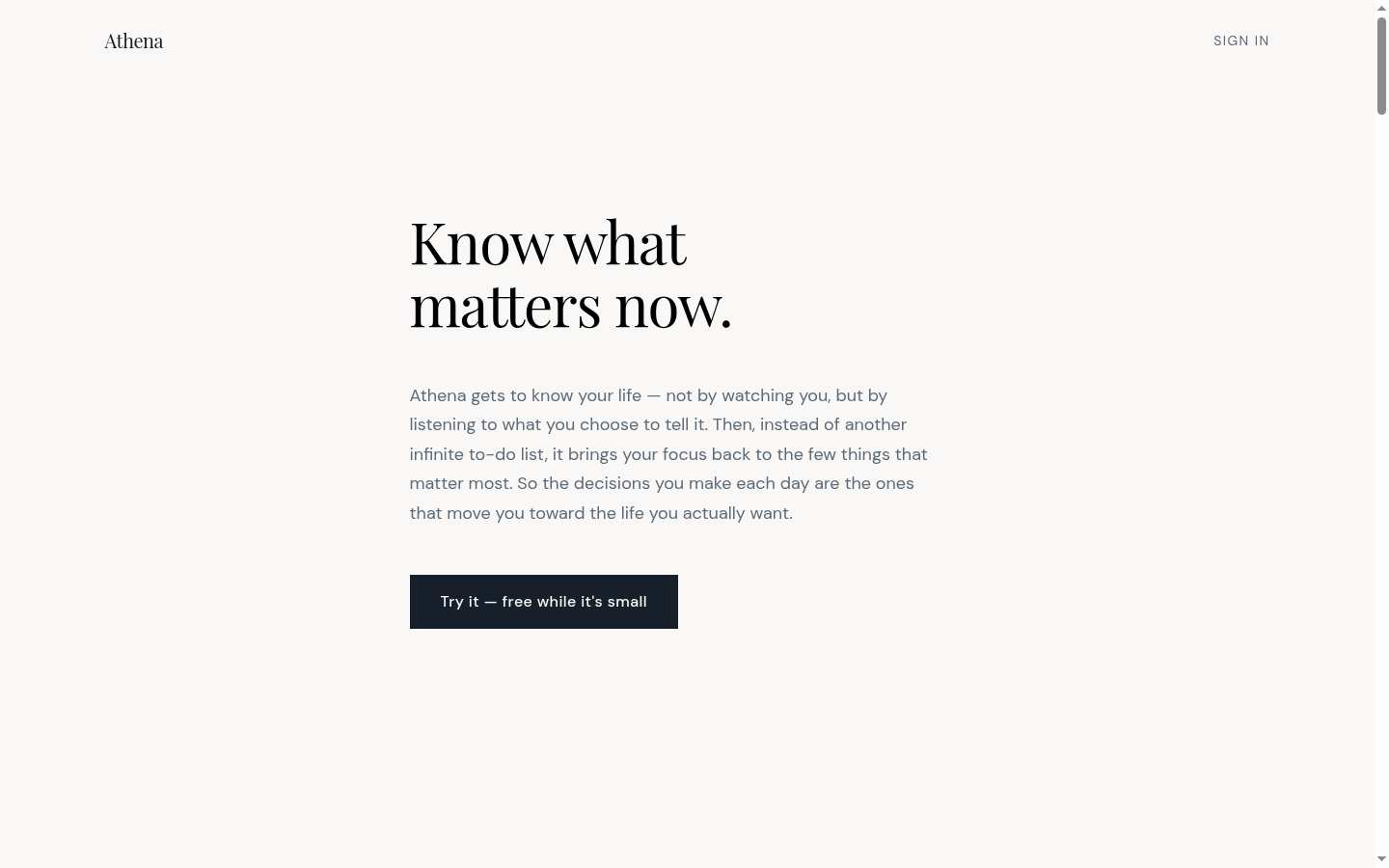
An AI assistant that listens to what you tell it and hands you a daily judgment of what matters
Athena asked for this review and paid for the write-up. The verdict is ours, and so is the rating.
This review is written from what Athena publishes about itself: the front page and the manifesto, the privacy policy effective 14 August 2026 and updated 1 November 2026, the terms of service last updated 6 October 2026, and five of the founder's essays, read in November 2026. Nothing here comes from installing or running the product; the method was reading those documents closely. Where a claim rests only on the founder's own account and no dated policy stands behind it, the text says so.
The short answer
Athena is a personal assistant that knows only what you choose to tell it. You speak or type half-thoughts, decisions and promises; it keeps a record of your life with your consent at every entry, and each morning it writes a short briefing naming what deserves attention today, what can wait, and one thing you have quietly let go cold. In the evening it asks a single question about your day, drawn from your own open threads, and your answer becomes part of the record. It is built for founders, operators and anyone whose ambitions outnumber their hours. It is free while it is small. The honest constraint: it is a one-person product that will one day be paid, so anyone building a life on it should export early and often, which the product makes a one-click habit.
Screens from Athena
What Athena actually does
The product has one loop, and everything else hangs off it. You tell it things. It judges what matters. It speaks to you twice a day, once in the morning with a briefing and once in the evening with a question. Your answers feed the next briefing.
Morning   Athena reads your record
          and writes a one-screen
          briefing: what matters,
          what can wait, one thread
          gone cold
   |
Day       You live and you tell it
          things: notes, voice, files,
          "send this to Athena"
   |
Evening   One question about your
          day, chosen from open
          threads
   |
Night     Your answer is filed; the
          next briefing uses it
The morning briefing
The front page promises a briefing that takes ten seconds to read, a figure that is the founder's own framing rather than a measured one. What matters is the shape: it is a judgment, not a list. In the example printed on the site, the briefing picks out a deal signing as the day's one irreversible action, calls everything else background, and flags a promise made to Tom that is now three days old. The briefing names the reason things matter, and the reason is pulled from things you said earlier, weeks back.
Mechanically, when Athena composes a briefing it sends the context a request needs to Anthropic's models: your notes, memories, tasks, calendar context and conversation history. The privacy policy is explicit that the provider processes this to serve the request, does not train on it under its commercial API terms, and deletes it within 30 days. What comes back is Athena's own words to you. What you control is the record underneath: tell it something is done and the thread is finished, with the memories that depended on it retiring instead of competing with what is true now. Correct something and the old version is retired rather than left to fight the new one.
The evening question
At around half past seven, per the founder's essay, the phone asks one question. Yesterday it was whether the Q4 review had moved, because he had said it was the thing not to drop that week. The day before, it was whether a partner call had happened, because he had said on Monday he wanted it before making a decision. You answer in a sentence or two, sometimes with a thumb while dinner is on the stove. The answer is read the next morning by the thing that wrote the briefing, so the loop closes: a call that happened and produced a November follow-up puts that follow-up in tomorrow's briefing with the reason attached. A call that did not happen comes back, gently, until it does or until you say it no longer matters.
The founder claims he has not missed a day in two months, which is his own account and unverifiable, but the design reasoning behind it is documented and sound: a blank page asks you to decide what mattered, and a question has already done that deciding, and the answer goes somewhere that reads it.
What it keeps and what it drops
Judgment in this product is mostly a set of rules about time. The founder's essay on the subject describes the first version of the briefing treating everything ever told to it as equally alive, a task from three weeks ago sitting beside a thought from last night, and names that as the thing he spent the year fixing. The rules that came out of it are stated as product behavior:
| What you told it | What happens over time |
|---|---|
| A view about tomorrow's market | Gone by the end of the week |
| A rule written after a loss | Never expires; treated as standing |
| A plan scoped to a quarter | Alive until the quarter ends, then history |
| A thread you call finished | Stops being raised; dependent memories retire |
| A correction | The old version is retired; the new one stands |
Every memory carries its provenance, so the record can say where a belief came from. When something's time has passed, it is simply absent from the briefing rather than down-weighted in a list. The essay calls that housekeeping, then credits it as the biggest single improvement the briefing ever had, because judgment starts with the pile being the right size.
Ways to tell it things
The capture surfaces are where the product's philosophy is visible. Nothing enters the record without you having said it or approved it, and each surface has its own consent gate:
| Surface | What you do | What Athena receives | What enters without your say-so |
|---|---|---|---|
| Typing | Write a note in the app | The note | You wrote it, so it is yours |
| Dictation | Talk to it | A transcript; the audio is never stored | The words you said |
| Voice mode | Converse aloud | Live audio via ElevenLabs, OpenAI as backup; the words kept as a conversation marked spoken, plus session counts only | What you said |
| Files | Upload a document | It reads once and proposes what is worth keeping | Nothing; you confirm item by item, and rejected content is not stored |
| Claude connector | Say "send this to Athena" in a Claude conversation | A summarised proposal | Nothing; you tick the pieces you want |
| Phone shortcut | Use a Siri shortcut or Android automation | Text arrives as an ordinary note, over a personal capture token stored as a hash and revocable in Settings | The text you sent |
| Calendar | Connect Google or Outlook | A short rolling window of upcoming events, read-only | Nothing; events are never part of your long-term record, and disconnecting removes the cached events immediately |
| Another assistant | Bring over what it believes about you | Its claims | Athena fact-checks every claim with you before believing a word |
The privacy policy adds a detail worth knowing: Athena stores no audio at all. Speech is transcribed by ElevenLabs and OpenAI under their terms, and Athena keeps the words, never your voice. Spoken replies are generated from text by the same providers and not stored either.
The Claude connector
This is the feature that shows the product thinking hardest about real behavior. The founder's own essay on it, a five-minute non-technical guide published on the site, starts from a problem anyone who uses Claude heavily knows: you work something out in a conversation, it is good, and then it is gone, and Claude's own memory remembers in its own way, out of your sight, mixed with everything else.
The connector uses MCP, Model Context Protocol, a standard way for Claude to talk to another app. Setup, per the guide: in Claude on the web or desktop, add a custom connector with the URL athenaos.net/api/mcp, approve the connection with the same email code as your normal login, switch the connector on for a conversation, and say "send this to Athena" whenever something is worth keeping. There is nothing to install, and it works from the Claude mobile app once set up.
Claude conversation
  you say "send this to
  Athena"
        |
  Claude proposes a summary;
  nothing is stored yet
        |
  Athena shows the proposal
  in pieces
        |
  you tick some, discard
  the rest
        |
  kept pieces enter memory,
  each tagged with where it
  came from
Athena cannot read your Claude conversations. It receives only what Claude sends when you ask, and keeps only what you confirm. The essay explains why the confirmation step exists rather than Claude writing straight into memory: the founder does not think anything should enter a record of your life without you seeing it first, and it would have been easy to skip the step and call it seamless. Seamless, he writes, is how you end up with a memory full of things you never said.
Judgment built in as product law
The most revealing thing on the site is a single sentence the founder calls the most important in the product: connections are questions, never claims. The story behind it is that an early version told him a loss on one day was related to a decision from the week before. It was fluent, plausible and invented; the two records had nothing to do with each other. A human assistant who did that would be fired, the essay says, because an assistant who connects things that are not connected is worse than one who connects nothing. So Athena may notice that two things might be related and ask. It may not tell you they are.
The front page makes the same point in the product's own voice with a story about another assistant that was quite sure the founder has two children; he has none. Athena, it says, never invents a fact, and when it is not sure, it asks. The anecdote is marketing, but the rule it illustrates is documented behavior, and the import path in the capture table above applies it too: claims arriving from another assistant get fact-checked with you piece by piece.
The third judgment is silence. On a Saturday, Athena does not put work tasks in front of you whatever the deadlines say, because the founder told it once that weekends are not for that and it holds him to it harder than he holds himself. When a question would be a bad question, because you already answered it or the thing it is about has moved on, it asks nothing. A briefing shorter than yesterday's is, in the essay's words, often a better one.
What it does with your data
The privacy policy is the strongest document on the site, and it is worth reading by its date: effective 14 August 2026, updated 1 November 2026. It makes a short list of promises and then keeps the same promises in more detail, which is the right shape for a document of this kind.
The never list: no selling data, no ads, no sharing with advertisers or data brokers, no training of foundation models by Athena or, contractually, by its processors, and no routine human reading. Notifications are only the ones you agreed to, the morning briefing, the evening question and reminders of commitments you anchored to a time. Athena never sends notifications to win back your attention.
The complete processor list, with each one's job and what it sees:
| Processor | Job | What it sees |
|---|---|---|
| Supabase (Frankfurt, Germany) | Database, sign-in, file storage | Your email, everything you record, kept files and briefing audio; encrypted at rest and in transit |
| Anthropic | Composes briefings and answers | The text context a request needs; not used for training, deleted within 30 days |
| OpenAI | Whisper dictation, backup speech-to-text, standby voice | Dictation audio, live audio when the primary provider is unavailable; same 30-day, no-training terms |
| ElevenLabs | Primary voice-mode transcription, spoken replies | Live voice audio and the text it turns into speech |
| Resend | Email delivery | Your address and the content of emails Athena sends, and your replies |
| Cloudflare (R2) | Encrypted off-platform backups | A weekly copy of the database tables, kept four weeks on a rolling basis |
| Replit | Hosting and cookie-less analytics | Every request; approximate visitor counts with no tracking identifiers |
| Microsoft, Google | Calendar, only if connected | Upcoming events under a read-only permission you grant directly |
Two honest limits are stated rather than hidden. Athena is not end-to-end encrypted, and the policy explains why in one line: a system that composes your briefing must be able to read what you told it, so the product competes on being provably fair with your data rather than on claims that cannot survive scrutiny. And access to the production database is limited to one person, the founder, for emergencies, helping you with your own account at your request, or when the law requires it; the policy calls that the complete list. Rights under the EU/UK GDPR and the UAE Personal Data Protection Law are honored for all users wherever they live. Export produces a single portable file with your notes, memories, tasks, conversations, briefings and reflections, described as everything Athena holds for you, not a summary. Deletion is immediate, with encrypted backups rotating out within four weeks.
What it costs
There is no pricing page. What exists about money is consistent across the front page and the terms, and it amounts to an unusual arrangement: free now, paid later, free forever for early users.
| Question | What the documents say |
|---|---|
| Today | Free while it is small; sign-in by email code, no password and no card |
| Later | "One day it will be a paid product, and not a cheap one" |
| Early users | "The people who helped it grow will keep it free" |
| Before any charge | You will be told in advance, with reasonable notice; no silent charges, per terms section 7 |
| If it goes wrong | Liability capped at the greater of USD 100 or what you paid in the prior twelve months |
| Governing law | Dubai and the applicable federal laws of the UAE, disputes in the Dubai courts |
The terms name the operator: Mirco Neri, who runs a commodity trading firm in Dubai and built Athena under Axyloris. Service is provided as is, features may change as the product evolves, and your ability to export your data will not be removed without notice. You must be 18 or over, and the terms allow one account per person. Emails from the founder are a personal channel rather than a marketing sequence: a welcome and two short notes at moments you cause are automated, and everything else is written by hand; one reply of "stop" ends them.
What is genuinely good
- Consent at every entry. Files, Claude sends and imported assistant claims all arrive as proposals you confirm piece by piece. Typing was never the price of admission, and capture was designed as a byproduct of things you already do.
- Judgment stated as rules. Connections are questions, never claims; time-expiry on predictions, permanence on rules; the Saturday silence. These are written down, not vibes in a launch post.
- A privacy policy with specifics. The full processor list with jobs and data seen, one named person with database access, 30-day AI-provider deletion, no audio stored, read-only calendars that never become long-term record, export and delete in one action each.
- The loop is small enough to survive a bad week. One briefing in the morning, one question at night. If capture collapses to nothing but the evening answer, the record still grows.
What to weigh
- Capture from a phone runs through a Siri shortcut or Android automation you set up yourself; there is no native app. The Claude connector does work from the Claude mobile app.
- The future price is unknown beyond "not a cheap one." Early joiners keep it free, but the terms promise notice, not a number.
- One operator, provided as is. Availability is not guaranteed, and the security posture is one careful person rather than a team.
- Not end-to-end encrypted, and the policy is upfront that it cannot be while the server composes your briefing.
- No email or message integration, by design. If your life runs through your inbox, Athena will never see it, and the briefing reflects only what you chose to say.
Who it fits and who it does not
The manifesto says the product is for people who drift: not a lack of ambition, but days that happen by default while urgency crowds out importance. The front page is blunter about fit. If your life fits in a to-do app, you do not need Athena. If you have ended a full day unsure whether you moved the things that actually matter, that is the problem it exists to solve. Founders and operators are named, along with anyone with a company, a career, a season, a family or a five-year plan they intend to keep.
The clearest fit is a person whose thinking already happens in conversations, especially Claude conversations, and whose remembering happens nowhere. The connector is built precisely for that shape of mind. The second fit is someone who has tried ambient assistants and been burned by confident fabrication; the questions-not-claims rule and the piece-by-piece import are for them. The third is anyone who wants their memory in a jurisdiction and contract they can read, which the Frankfurt database, the dated policy and the one-person access list provide.
It is not for teams or shared workspaces; the terms allow one account per person and the product is about one life, not a project. It is not for anyone who wants the assistant to go read everything and get out of the way, because this one has opinions about never doing that. And it is not for anyone under 18.
You can test the shape before signing up, using the founder's own no-software version: write one sentence each morning about the thing that must not be dropped, answer one question each evening about whether it moved, and see if you make it to day seven. If you do, Athena is the thing that asks the question, remembers the answer, and puts it in front of you the next morning with the reason attached. It is free while it is small, an email code gets you in, and the export button is in Settings.
FAQ
What is Athena?
Athena is a personal assistant, operated from Dubai by Mirco Neri under Axyloris, that keeps a record of your life built only from what you choose to tell it. Each morning it writes a short briefing judging what deserves attention today, and each evening it asks one question about your day drawn from your own open threads. It connects read-only to Google or Outlook calendars, accepts typed and dictated notes, files and Claude conversation summaries, and never invents facts: when it is unsure, it asks. It is free while it is small.
How much does Athena cost?
Nothing today. Athena is free while it is small, with sign-in by email code and no card. The front page says it will one day be a paid product, and not a cheap one, but that everyone who joins before then will know in advance, and the people who helped it grow will keep it free. The terms, last updated 6 October 2026, add that no charge will ever be introduced silently and that reasonable notice comes first.
Does Athena read my email or watch my activity?
No. Athena knows only what you provide or approve, which is how the terms define it, and it has no email or message integration at all. Calendar access, if you connect Google or Outlook, is read-only, covers a short rolling window of upcoming events, and those events are never converted into your long-term record. The privacy policy, effective 14 August 2026, lists every processor that touches your data and what each one sees.
How does the Claude connection work?
In Claude on the web or desktop, you add a custom connector with the URL athenaos.net/api/mcp, approve it with your normal Athena email code, and say "send this to Athena" in any conversation with the connector switched on. Claude proposes a summary, nothing is stored yet, and Athena shows you the proposal in pieces you tick or discard. Only what you ticked entered your memory, tagged with where it came from. Athena cannot read your Claude conversations.
Can I export or delete everything?
Yes, both directly in the product, in one action each. Export produces a single portable file containing your notes, memories, tasks, conversations, briefings and reflections, described in the privacy policy as everything Athena holds for you, not a summary. Deleting your account erases your data permanently and immediately, with encrypted backups rotating out within four weeks. Both can also be requested by email at privacy@athenaos.net.
Who runs Athena, and under what law?
Athena is operated by Mirco Neri, who runs a commodity trading firm in Dubai and built the product under Axyloris. The terms of service are governed by the laws of the Emirate of Dubai and the applicable federal laws of the United Arab Emirates, with disputes subject to the Dubai courts. Access to the production database is limited to the founder alone, for emergencies, for helping you with your account at your request, or when the law requires it.
Is Athena end-to-end encrypted?
No, and the privacy policy says so directly. A system that composes your briefing on a server must be able to read what you told it, so the product states it competes on being provably fair with your data rather than on encryption claims that cannot survive scrutiny. Data is encrypted in transit and at rest, the database runs in Frankfurt, calendar credentials use authenticated encryption, and no processor gains rights to your content or trains on it.
Is there a mobile app?
There is no native app. Athena is a web product, and capture from a phone runs through a Siri shortcut or an Android automation you set up, which sends text in as an ordinary note over a personal capture token you can revoke in Settings. The Claude connector does work from the Claude mobile app, so "send this to Athena" is available on a phone once the connector is configured. Voice mode handles dictation and spoken replies through ElevenLabs and OpenAI.